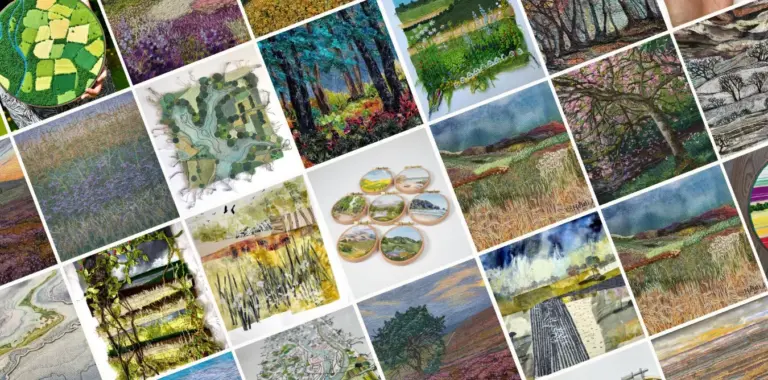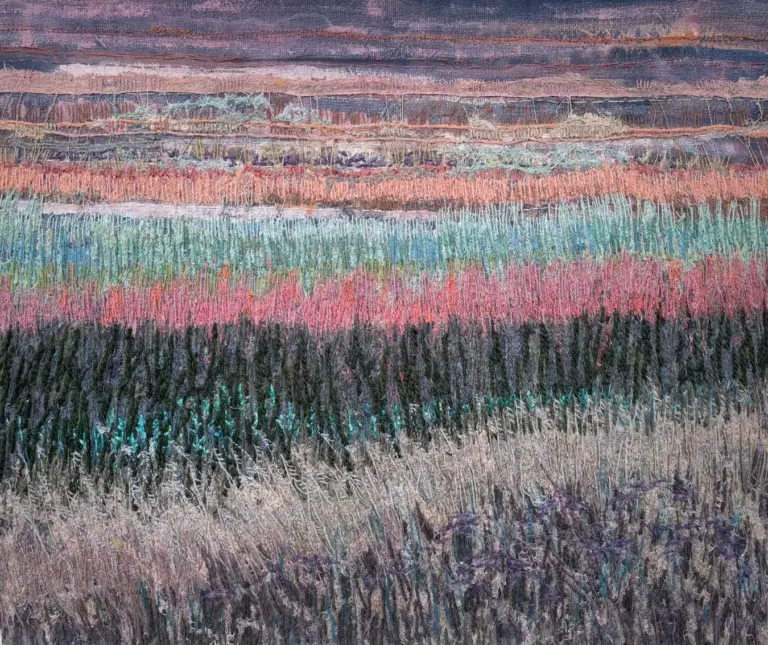
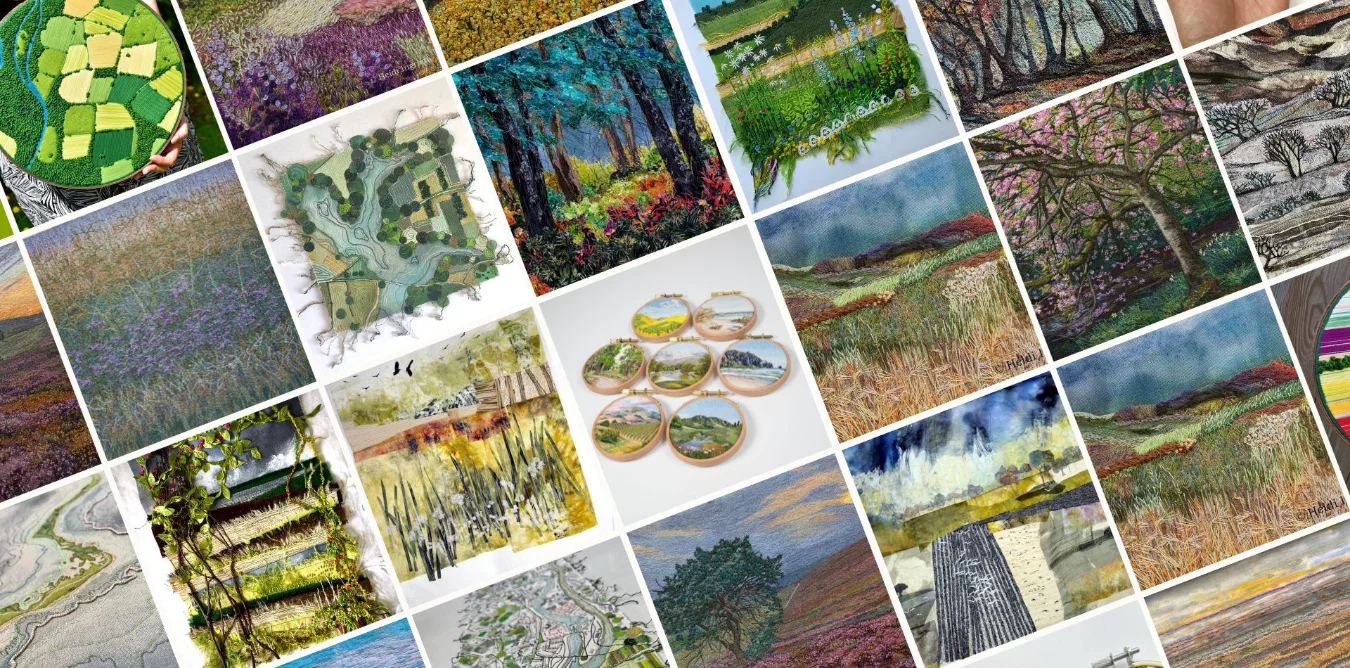
There is something about landscape that calls to the textile artist. Perhaps it is the way a field at dusk resists being captured in a single colour, or the way light moves across moorland in a way that only thread, not paint, seems able to hold. Whatever the reason, textile artists inspired by landscape are producing some of the most breathtaking and emotionally resonant work being made today.
This is the latest addition to our Artists You HAVE to Follow series, and it may be our most ambitious yet. We have sought out ten remarkable textile artists working across embroidery, mixed media, machine stitch, thread painting, applique, and more, all united by a deep and abiding love of landscape. From the Yorkshire Dales to the Scottish Highlands, from hand-stitched aerial views of the English countryside to impressionistic thread-painted cliffsides in Southern California and landscapes of Wisconsin, there is extraordinary range here. Whether you are already studying with us or just beginning to explore what textile art can do, these artists will stop you mid-scroll and remind you exactly why you fell in love with stitch in the first place.
1. Kate Tarling
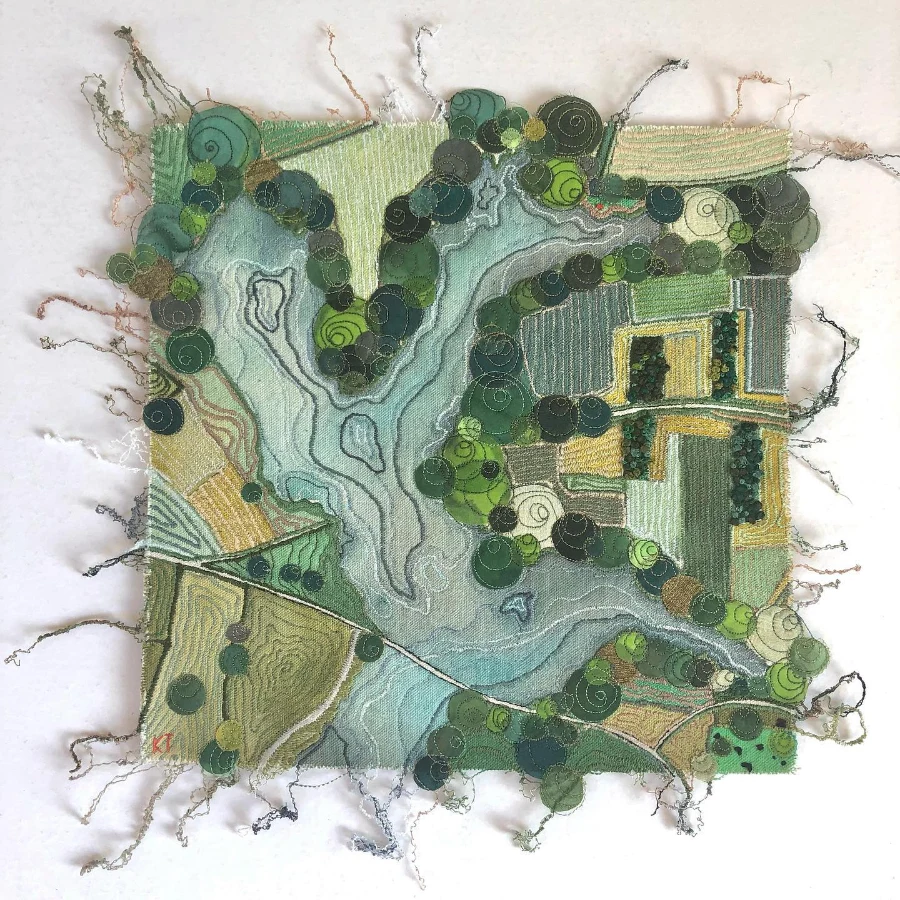
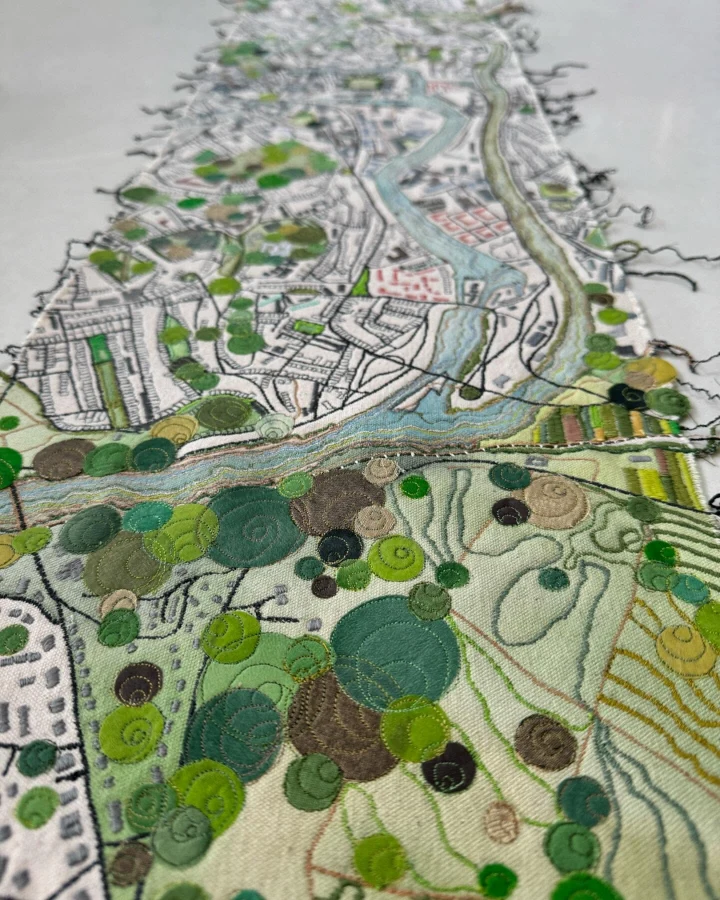
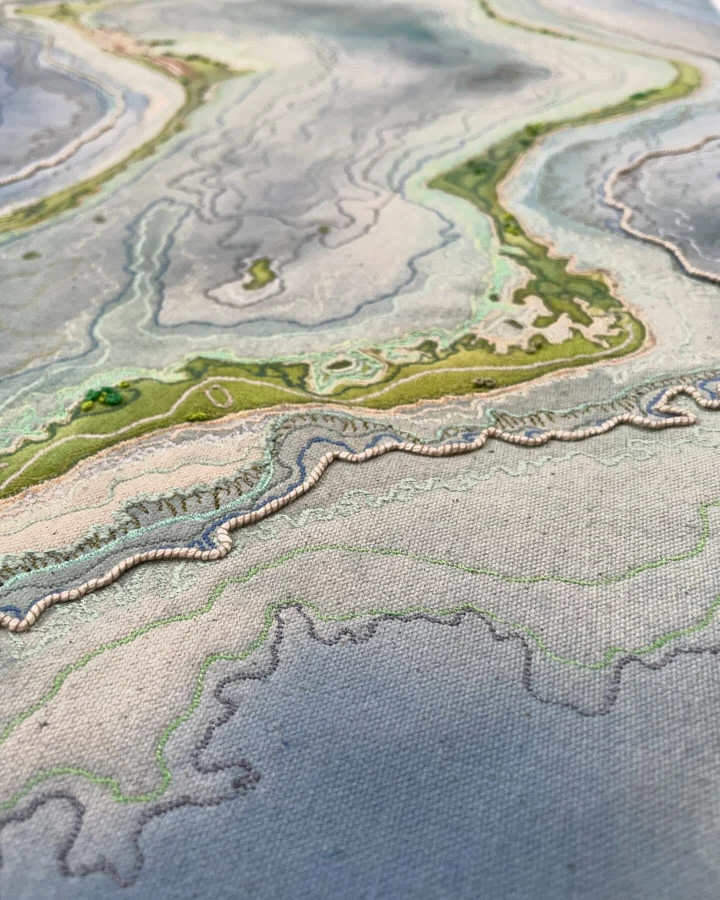
If maps could feel, they would feel like Kate Tarling’s embroideries. The British textile artist creates stitched maps of real geographical locations using freehand machine embroidery, silk paint, and silk appliqué. Each piece is rooted in actual geography, researched through Google Maps and satellite imagery, but interpreted through an entirely personal and tactile lens.
Across commissions spanning locations across the globe, Tarling has developed a practice that sits beautifully at the intersection of place, memory, and making. Trees emerge as dimensional silk appliqué. Colours shift with the emotional truth of the land rather than its literal hue. It is a practice with geography at its heart: she trained as a journalist and holds a degree in geography, and that combination of precision and storytelling runs through everything she makes.
What makes Tarling’s work so compelling for textile artists is her commitment to process. She lays down silk paint onto canvas before a single stitch is placed, building atmosphere before building structure. Maps imply precision above all else, but Tarling’s work offers something richer. It offers a felt sense of place.
Her own words say it best: “When you’re stitching, you’re stitching footsteps into that landscape.”
Follow Kate Tarling
Instagram: @katetarlingtextiles
Website: katetarlingtextiles.com
2. Rachel Wright
Rachel Wright’s current project, The Stitched Garden, is a sustained exploration of the gardens, riverside, and surrounding countryside at Waterperry in Oxfordshire, with the resulting works displayed at The Waterperry Gallery. It is a fitting subject for an artist whose practice is rooted in close observation of the natural world, and it gives a clear sense of how Wright works: slowly, attentively, and with deep commitment to the places she depicts.
Her technique is machine embroidery on calico. She begins by sketching the composition directly onto the fabric, then builds the image through the sewing machine, changing threads as often as required to achieve the full range of colour and tone in each piece. It is painstaking work, and she is candid about that: each piece is carefully crafted, and she gives herself time to step back, live with the work, and revise before she considers it finished.
Across her wider practice, Wright moves between seascapes, countryside, wildlife, and architectural subjects, all united by that same careful eye and willingness to stay with a subject until it is truly resolved. A member of the Buckinghamshire Craft Guild, her work is exhibited through galleries across Oxfordshire and the surrounding region.
Follow Rachel Wright
Instagram: @rachelsetford
Website: rachelwright.com
3. Victoria Rose Richards
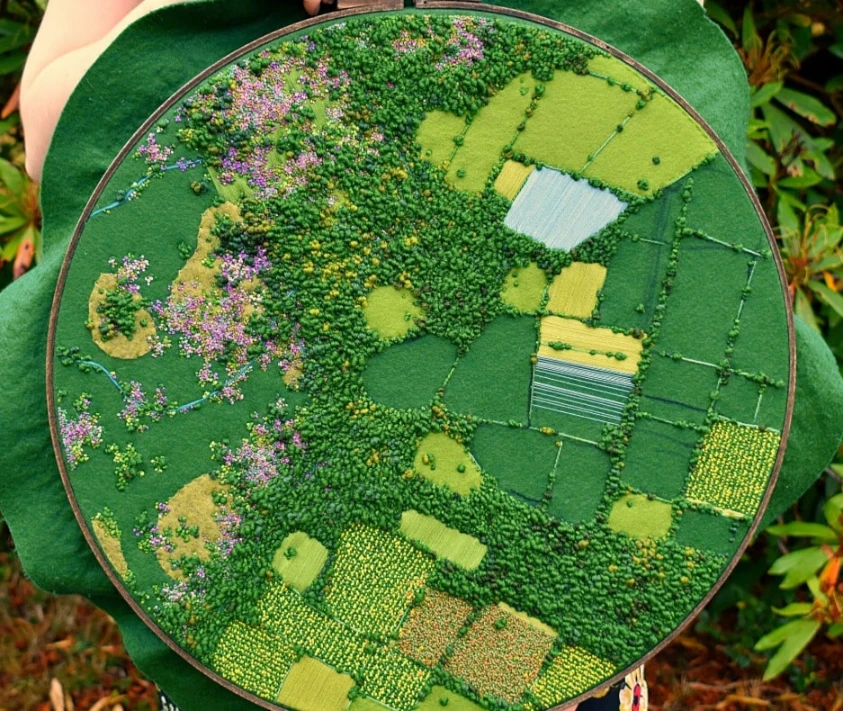
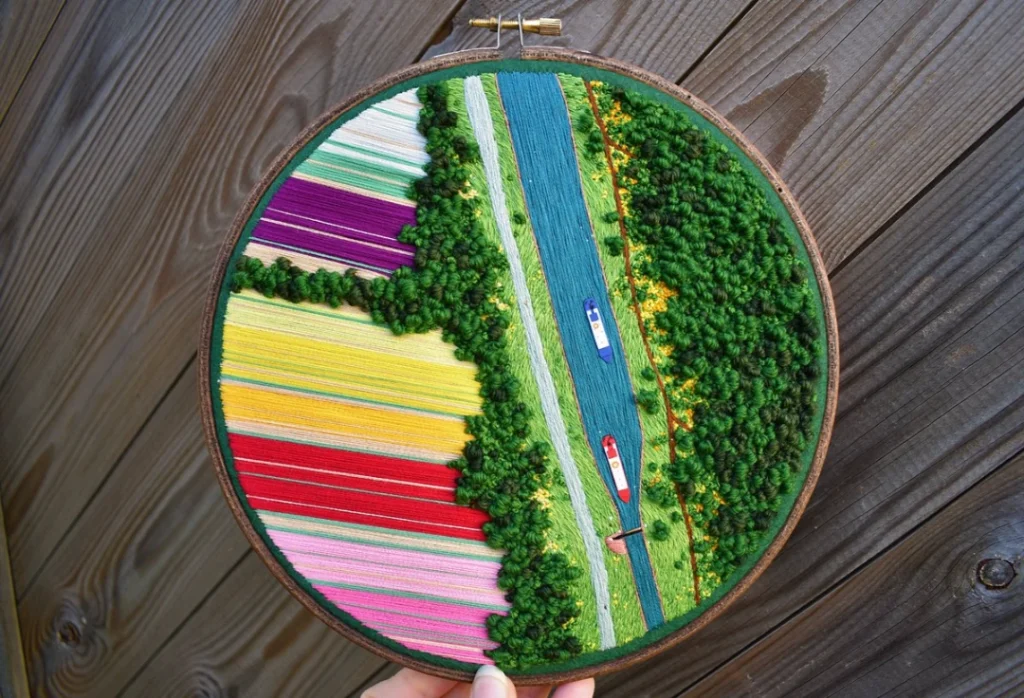
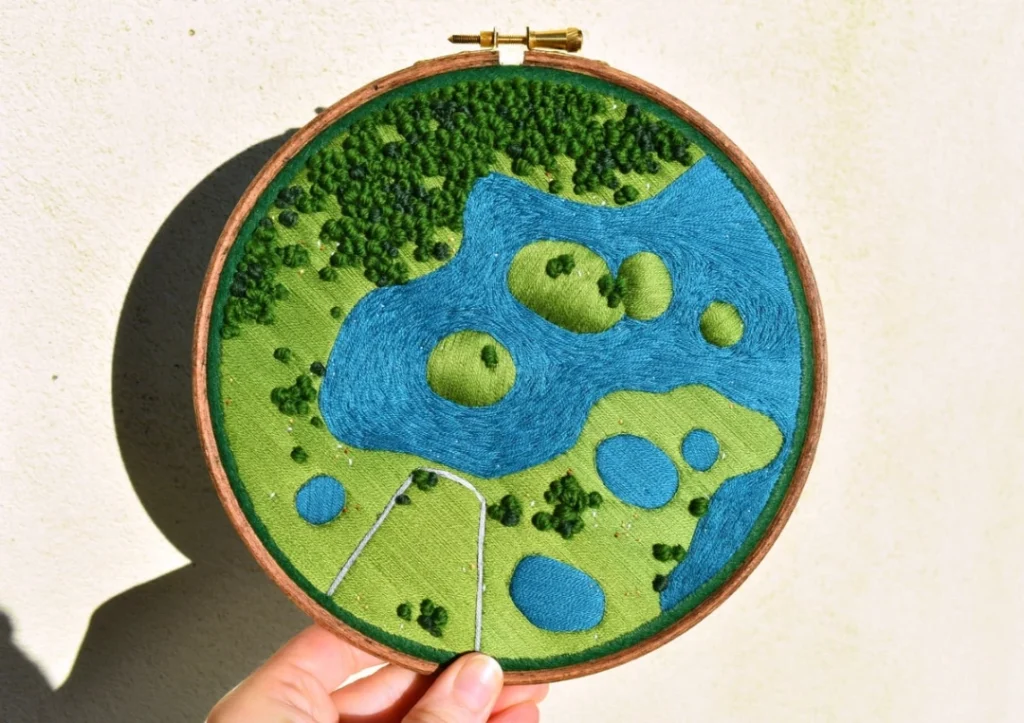
Victoria Rose Richards sees the British countryside from above. Her embroideries offer an aerial perspective of the English landscape: classical gardens, vineyard rows, countryside fields, rivers, and mazes viewed as if from an aeroplane window. Each piece is rendered in French knots, 3D clusters of thread, and precise geometric stitching that is immediately recognisable as hers.
Richards discovered embroidery in 2018 through her grandmother’s supplies, and what began as a connection to family quickly became a distinctive and internationally recognised artistic practice. On the autism spectrum, she finds deep meaning in symmetry and repetition. “I find symmetry very comforting and calming,” she has said, and that quality of absolute order runs through every piece she creates.
We have featured Victoria Rose Richards on SST before and we make no apology for returning to her here. Her perspective on the British landscape is unlike anyone else working today. Where other artists stitch the view from the path, Richards stitches the view from the sky, reframing the utterly familiar in a way that feels genuinely new every time.
Follow Victoria Rose Richards
Instagram: @victoriaroserichards
Website: victoriaroserichards.co.uk
4. Caroline Dunn
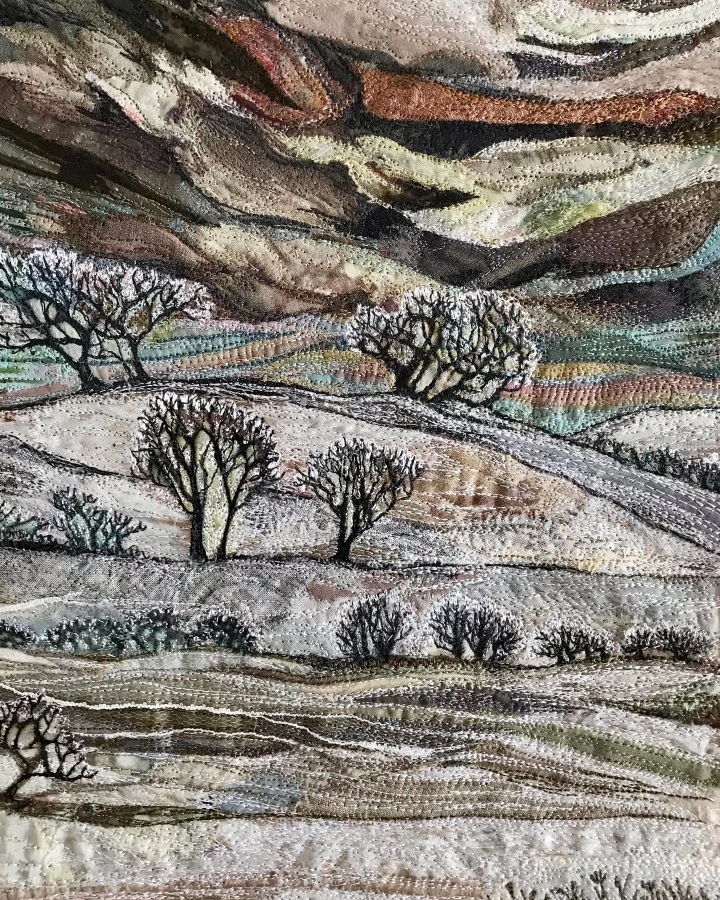
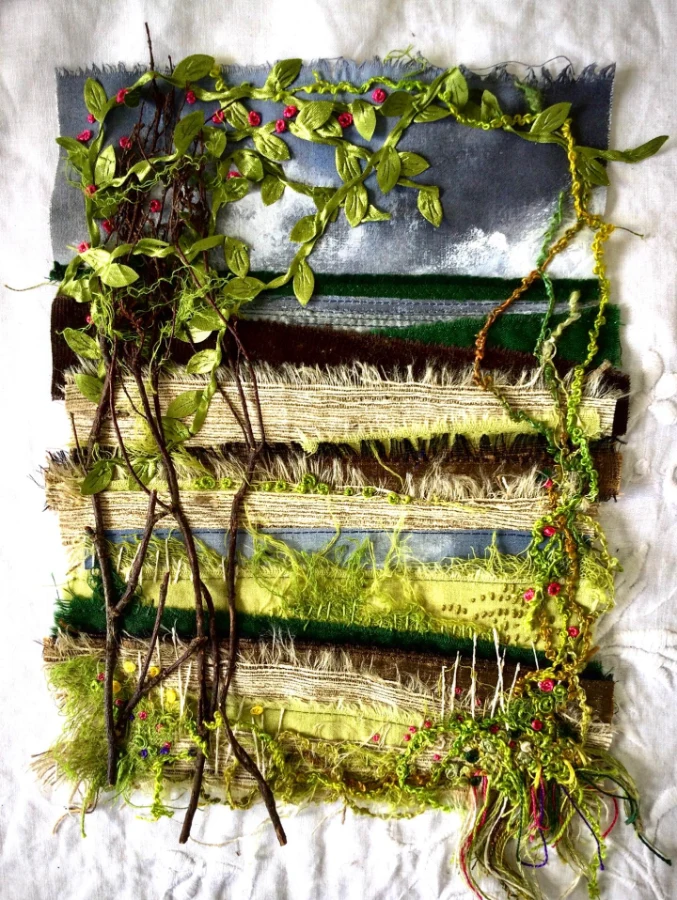
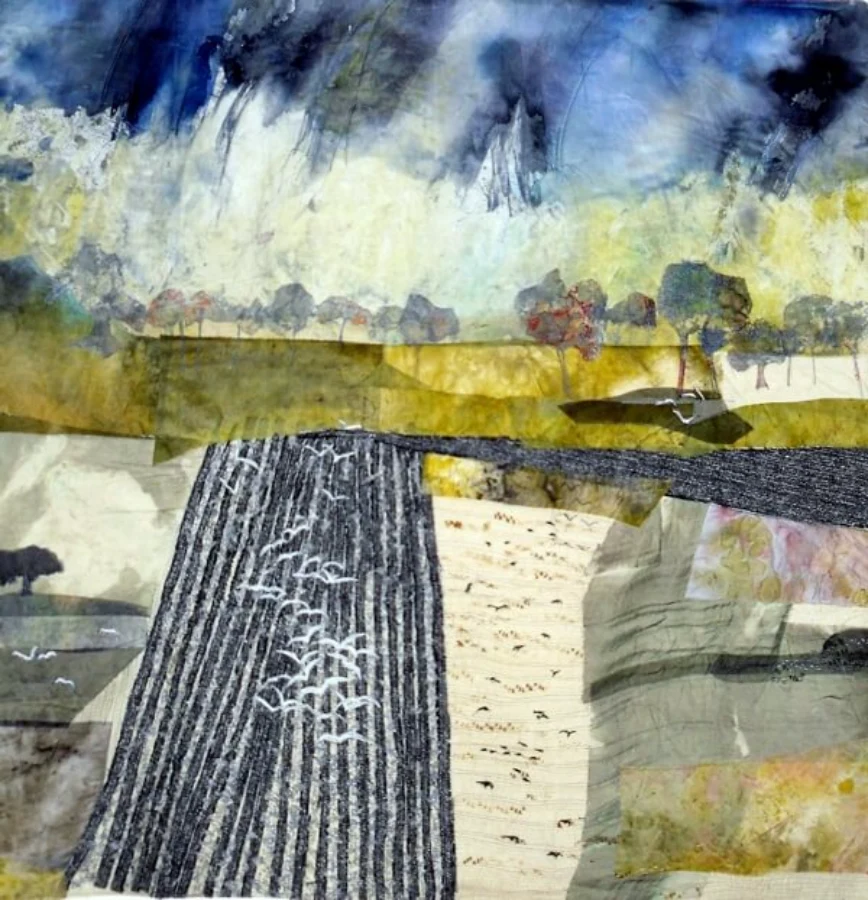
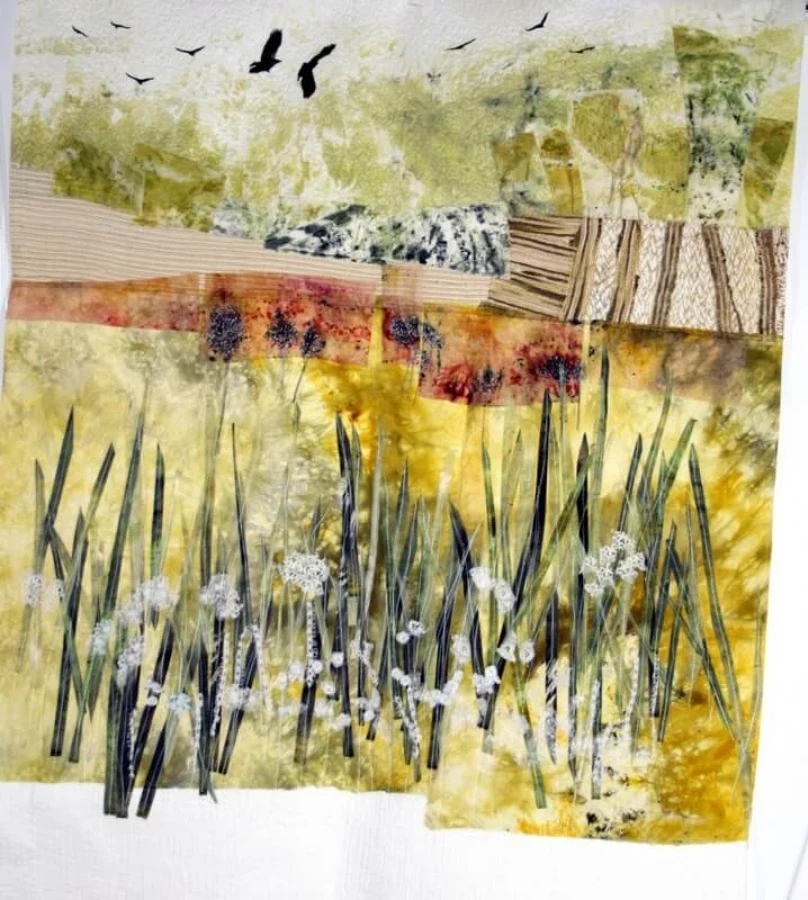
Caroline Dunn lives and works on the southern edge of Wensleydale in the Yorkshire Dales, and it shows in every thread. Her mixed media textile work captures the texture and character of that particular northern landscape: patchwork fields, winter skies, and crows and rooks picking across open ground. The richness and specificity of her work is the kind that only comes from genuinely knowing a place across years and seasons.
Her process begins with natural fabric backgrounds prepared through painting and dyeing. From there, she builds layers of appliqué and machine and hand stitching across the surface. Alongside her landscape work, Dunn also explores medieval art and architecture, a secondary influence that surfaces in the stylised, considered quality of her bird studies. The two strands of her practice share the same quality of close looking.
She brings considerable academic depth to her making: her training includes a City & Guilds embroidery course, an HND in multimedia textiles, and both an MA in Contemporary Applied Arts and a PhD. Her work has been shown at New Designers in London. For any SST student who finds inspiration in the British countryside, she is an essential reference point.
Follow Caroline Dunn
Website: carolinedunn.weebly.com
5. Fiona Robertson
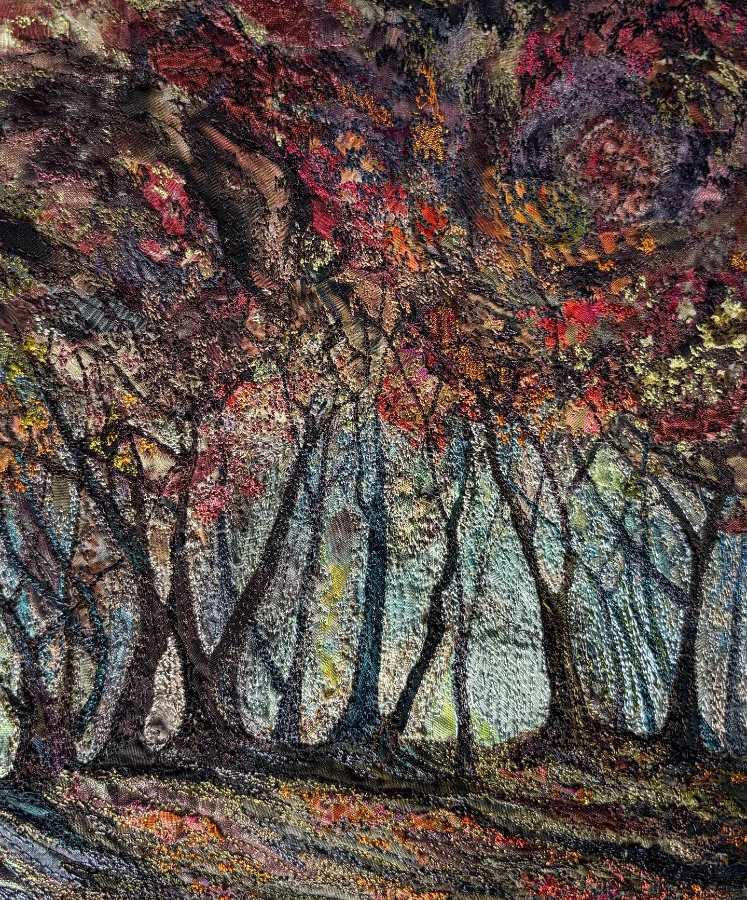
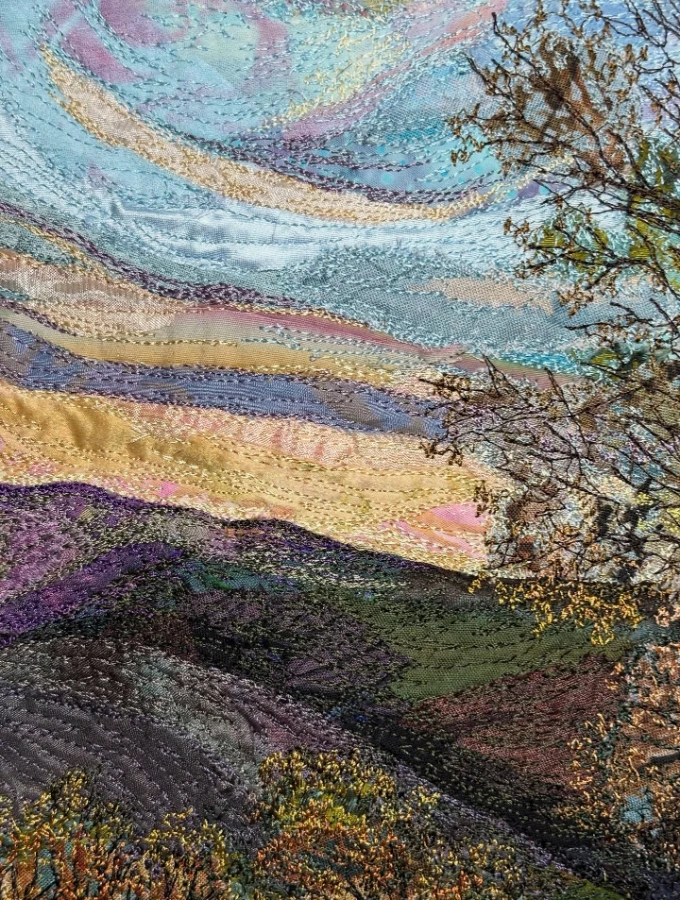
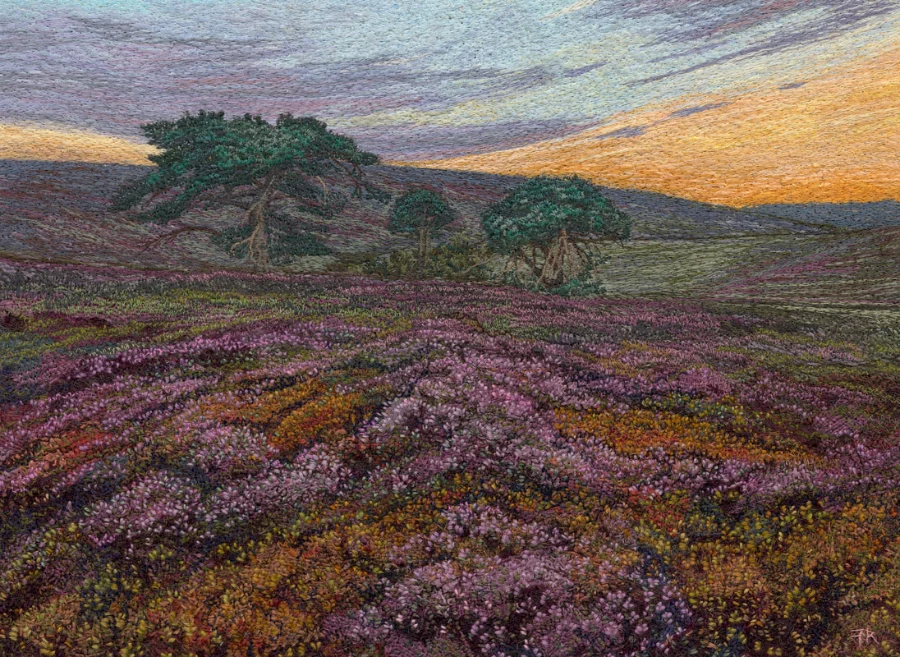
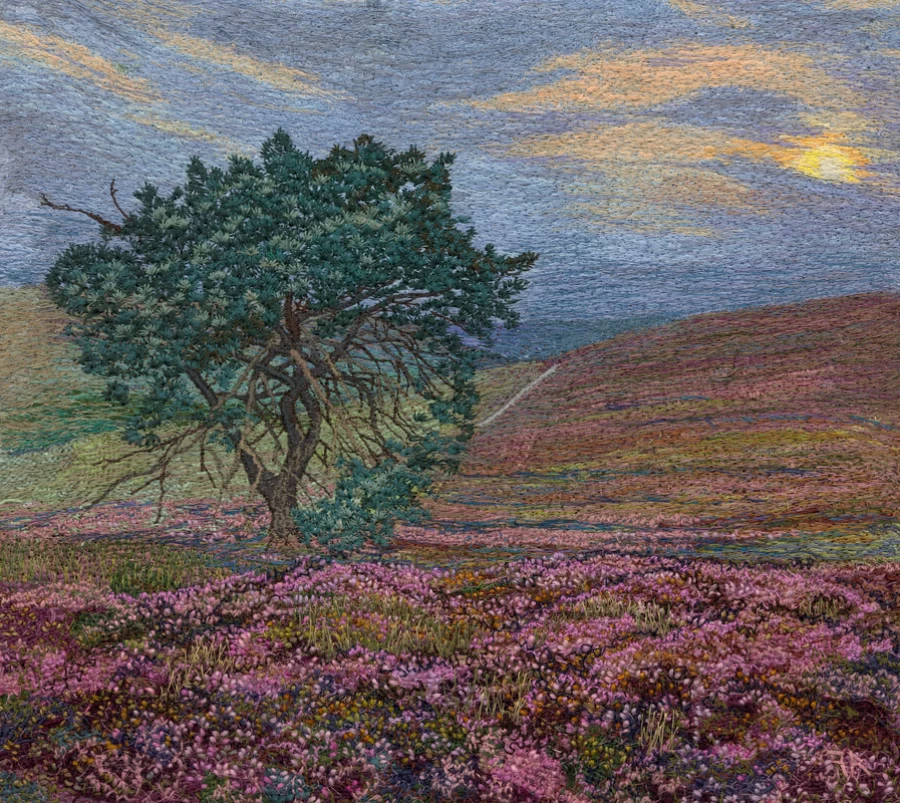
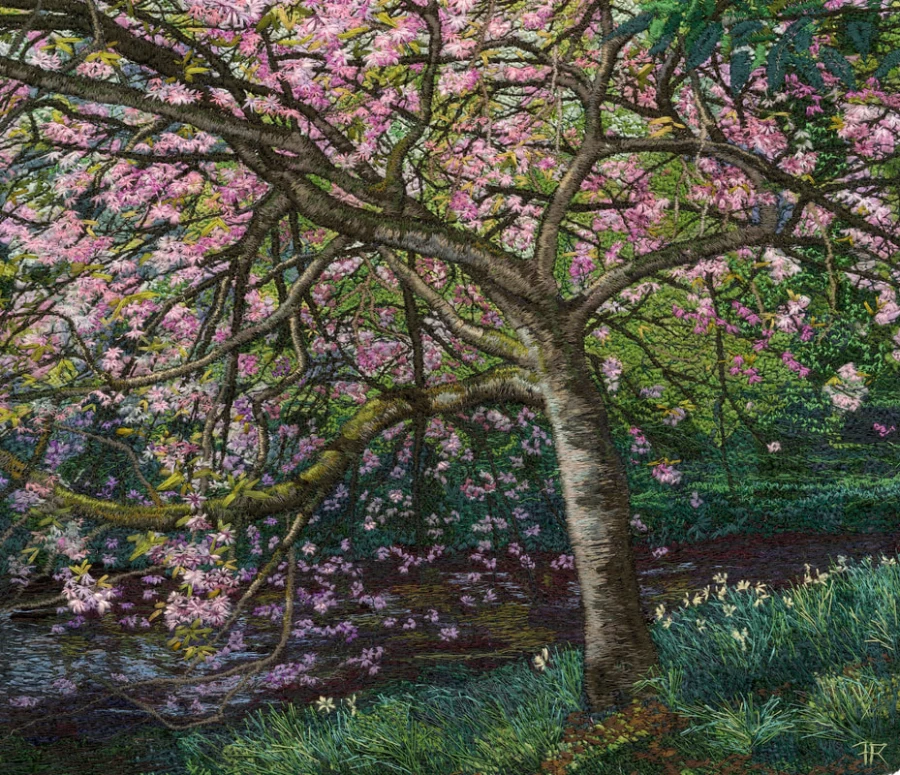
Fiona Robertson works with both free motion machine and hand stitching to create fine art embroideries inspired by the rhythms, colours, and textures of the natural landscape. Based in North Yorkshire, her practice is deeply informed by the particular quality of that northern light: the way moorland shifts colour from hour to hour, and the way oak trees hold the last of the autumn gold against a grey November sky.
Each piece begins with careful observation and sketching before moving through layers of hand-dyed materials and machine work to build tone. The final stage is the slow, meditative work of hand stitching to add surface texture. Some pieces take several weeks to complete, and that investment of time shows clearly in the density and quietness of the finished work.
Robertson recently won the People’s Choice Award at North Yorkshire Open Studios, which is a telling accolade. Popularity with a general audience and credibility within the textile art world do not always coincide, but her work earns both with ease. Her embroideries are held in private collections across the UK, Europe, the US, Canada, and Australia.
Follow Caroline Dunn
Website: fionarobertsonartworks.co.uk
6. Deborah Collum
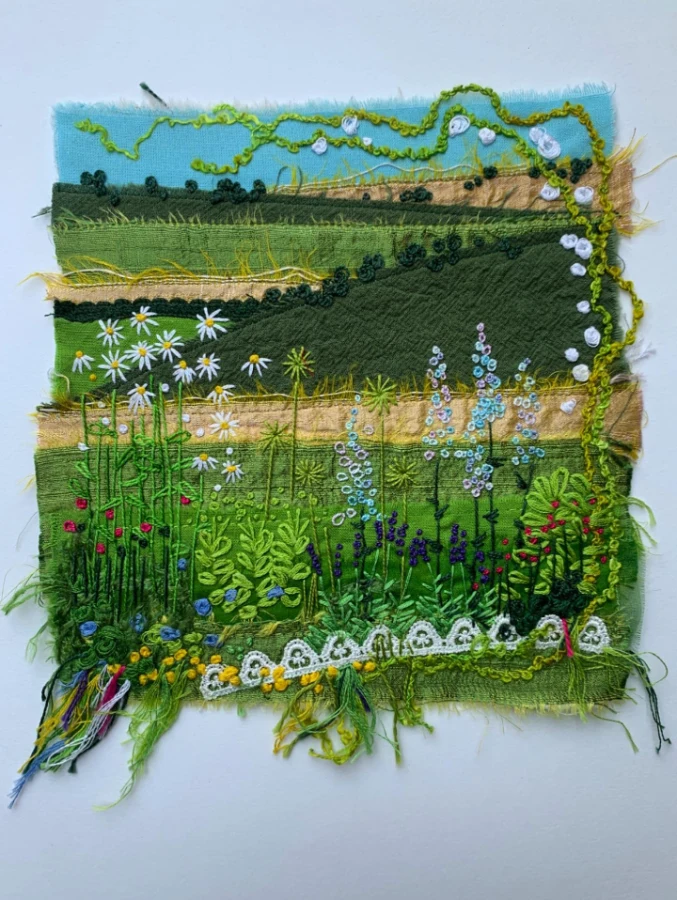
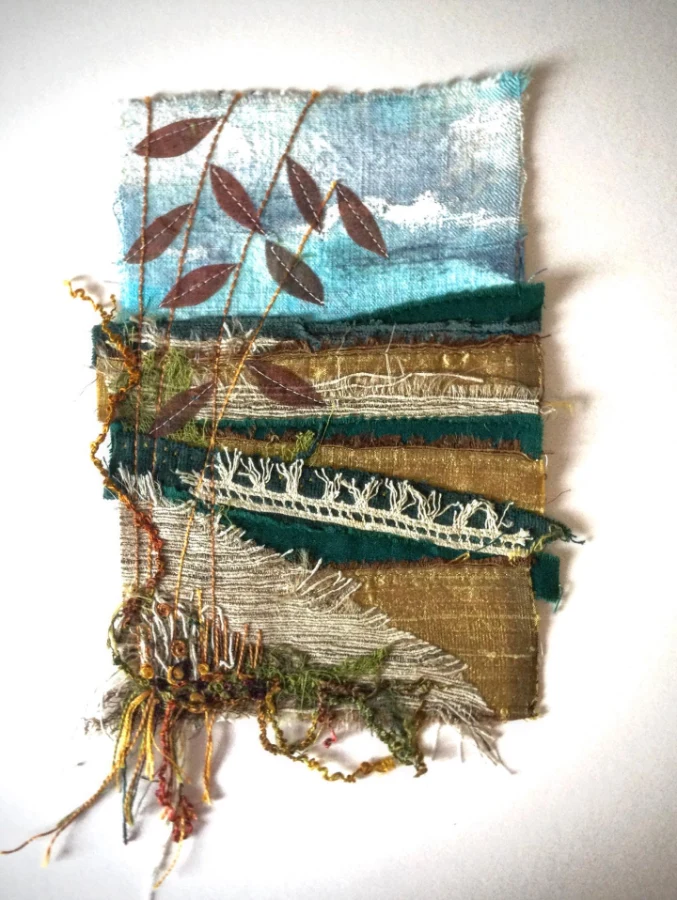
Deborah Collum’s work is rooted in a specific, much-loved patch of England: the Warwickshire countryside she walks regularly, with its rape fields blazing yellow in late spring, its bluebell woods, and its patchwork fields rolling gently toward the horizon.
Collum works with sari silk offcuts, dyed and painted calico, and, as she puts it herself, absolutely anything that comes to hand. Her process is layered and intuitive, building stitch upon stitch and colour upon colour in pieces that she sees as a continuation of generations of women’s domestic textile craftsmanship. More, she insists, is most definitely more when it comes to stitch.
She teaches Textile Landscapes workshops at Leamington Studio Artists, which tells you something important about her standing. This is an artist with enough of a practice and enough of a perspective to share it meaningfully with others. Her work is available through her Etsy shop and exhibited through local galleries near Stratford-upon-Avon.
Follow Deborah Collum
Instagram: @deborahcollumloveart
Website: deborahcollumloveart.uk
7. Heidi Ingram
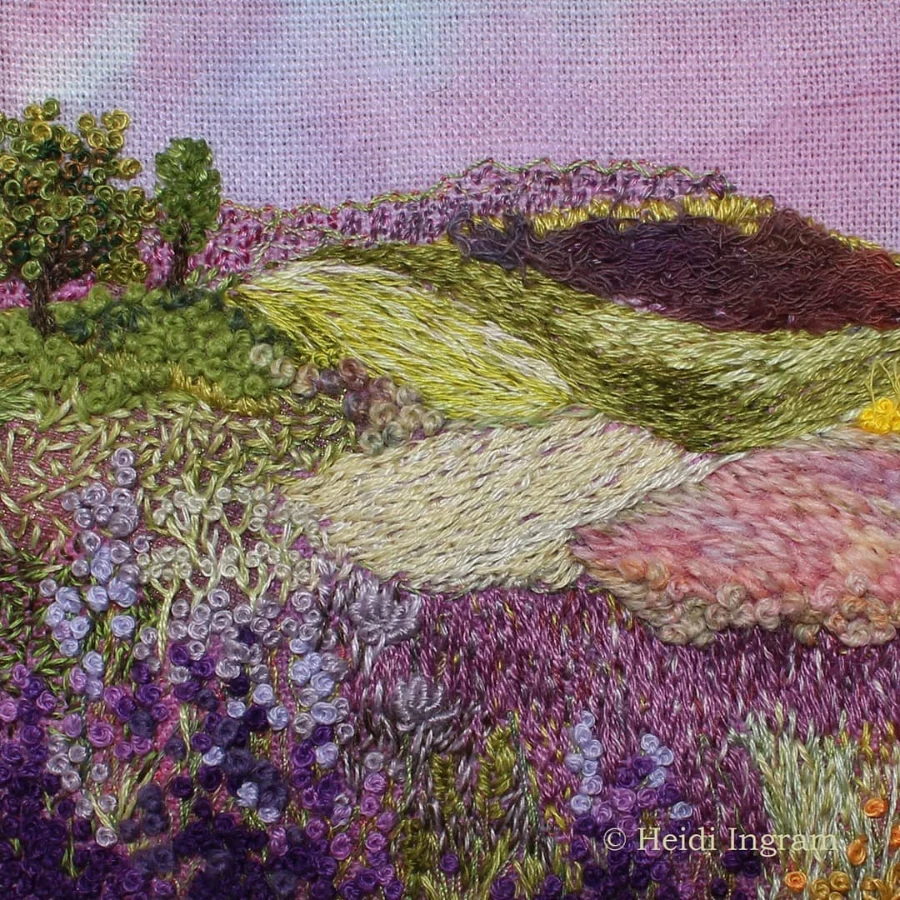
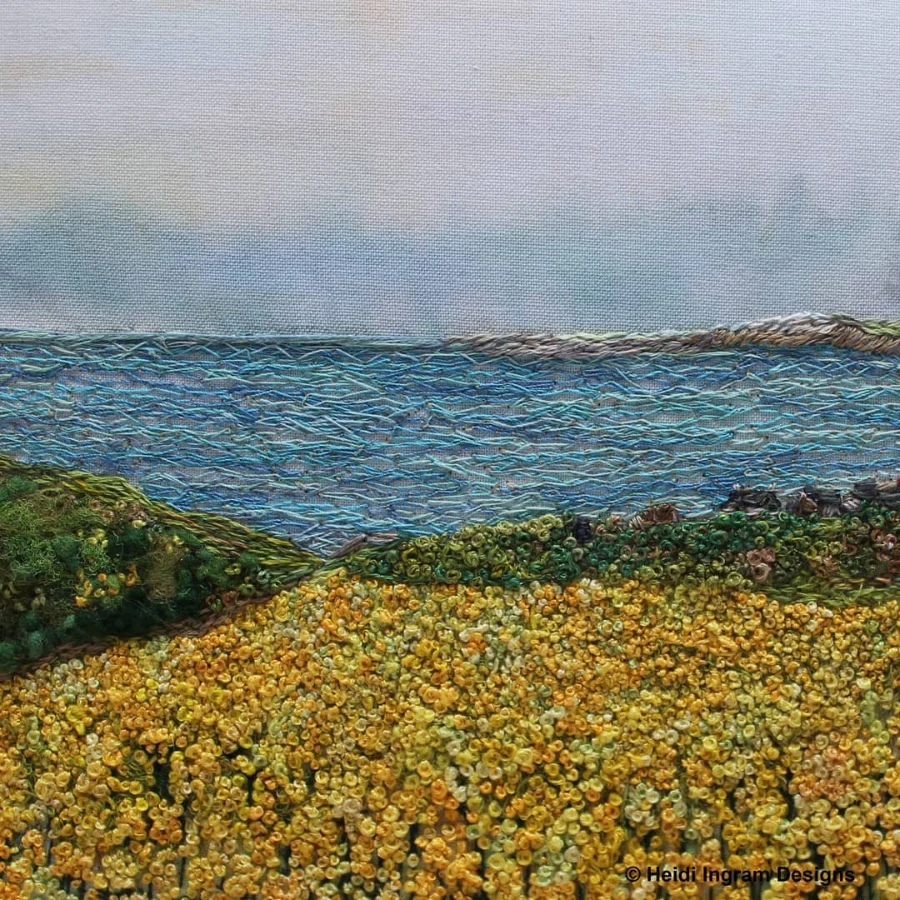
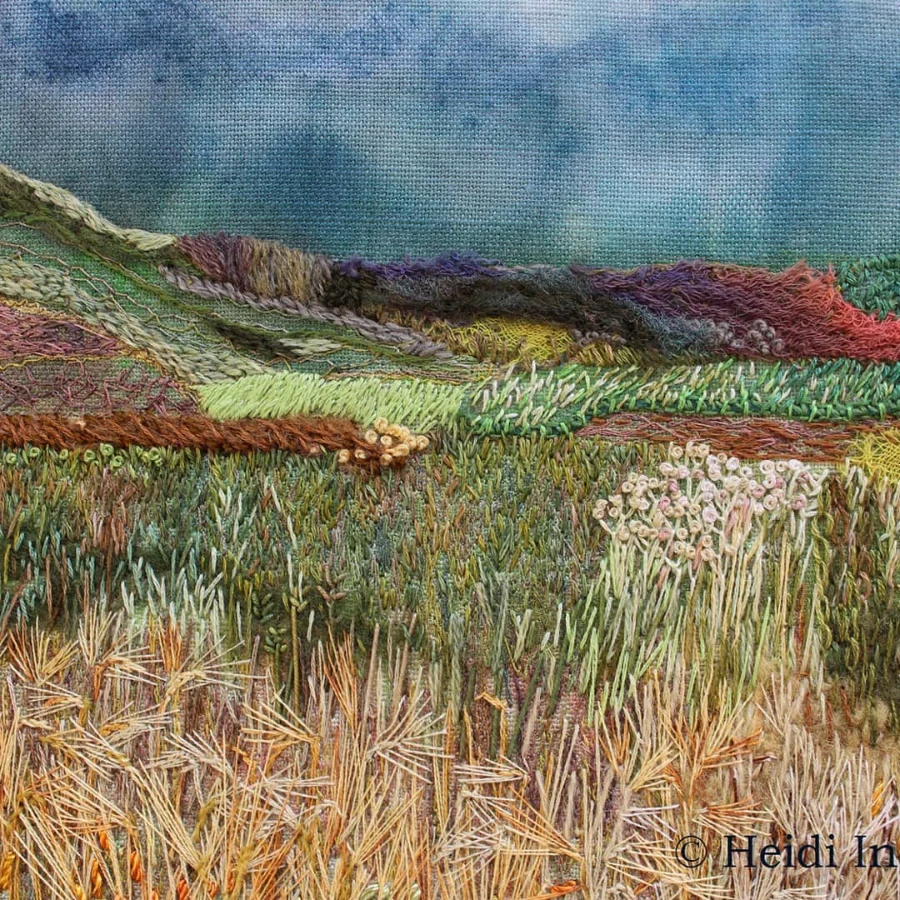
Heidi Ingram lives in East Lothian, and her work is a love letter to that particular stretch of Scotland: its farmland, woodlands, moors, and coastal edges. She works in layers of cloth and stitch, building surfaces that feel as textured and alive as the landscapes they describe, with appliqué and carefully placed hand stitching adding unexpected raised detail throughout.
What distinguishes Ingram’s practice is the seriousness with which she approaches landscape as a subject. This is not decorative countryside. Her work is informed by a genuine commitment to environmental stewardship and biodiversity conservation, to looking closely at what is there and bearing witness to it before it changes. As a result, her pieces carry an urgency that only comes from making work about something you genuinely care about.
Her work is exhibited through galleries across East Lothian and beyond, and her Instagram feed is a masterclass in how landscape textile art can be both commercially successful and artistically rigorous. For SST students who want to make work that carries meaning beyond technique, Heidi Ingram is essential looking.
Follow Heidi Ingram
Instagram: @heidiingramtextileart
Website: heidiingram.co.uk
8. Jan Beaney
No list of textile artists inspired by landscape would be complete without Jan Beaney. A Fellow of the Embroiderers’ Guild and longstanding member of the 62 Group of Textile Artists, Beaney has spent decades developing a practice entirely rooted in the close observation of the natural world. She remains one of the most important and influential figures in contemporary embroidery.
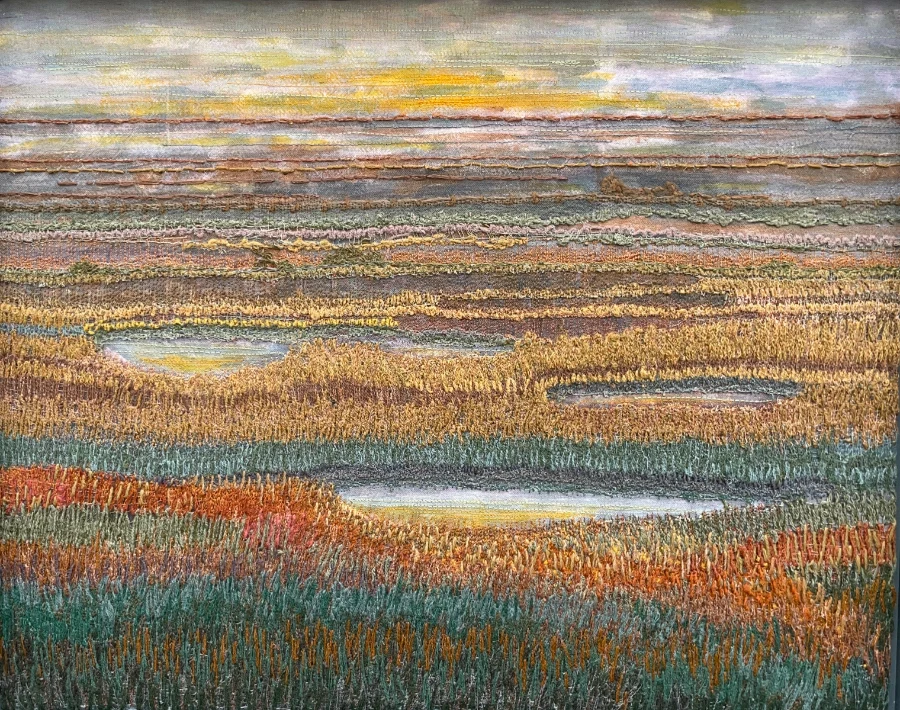
Her method is deceptively simple in description and extraordinary in outcome. Working on solufleece, she draws with coloured pencil before layering machine and hand stitching in fine wool threads. Through careful washing and stretching, the soluble base disappears, leaving a dimensional and textured piece that seems to catch light the way a real landscape does at a particular hour of the afternoon. Works like Wetlands, Pale Waters, and Quiet Beauty capture something that neither photography nor painting quite manages.
What makes Beaney’s approach so instructive for any textile artist is that it begins before the studio. She fills sketchbooks with quick observations made on walks: a view from a car window crossing the Australian outback, a moment’s pause on a local path. “The more you look, the more you see,” she says, and that discipline of looking feeds directly into the depth of what she ultimately makes.
We spoke to Jan in depth on the SST podcast, where she talked about how her sketchbook habit became the foundation of her entire practice. It is one of our most listened-to episodes and essential listening for anyone working with landscape as a subject.
Listen now to the episode, How Jan Beaney Turned a Sketchbook Habit into Machine Embroidery
Follow Jan Beaney
Instagram: @doubletroublejanjeanofficial
Website: doubletrouble-ent.com
9. Cassandra Dias
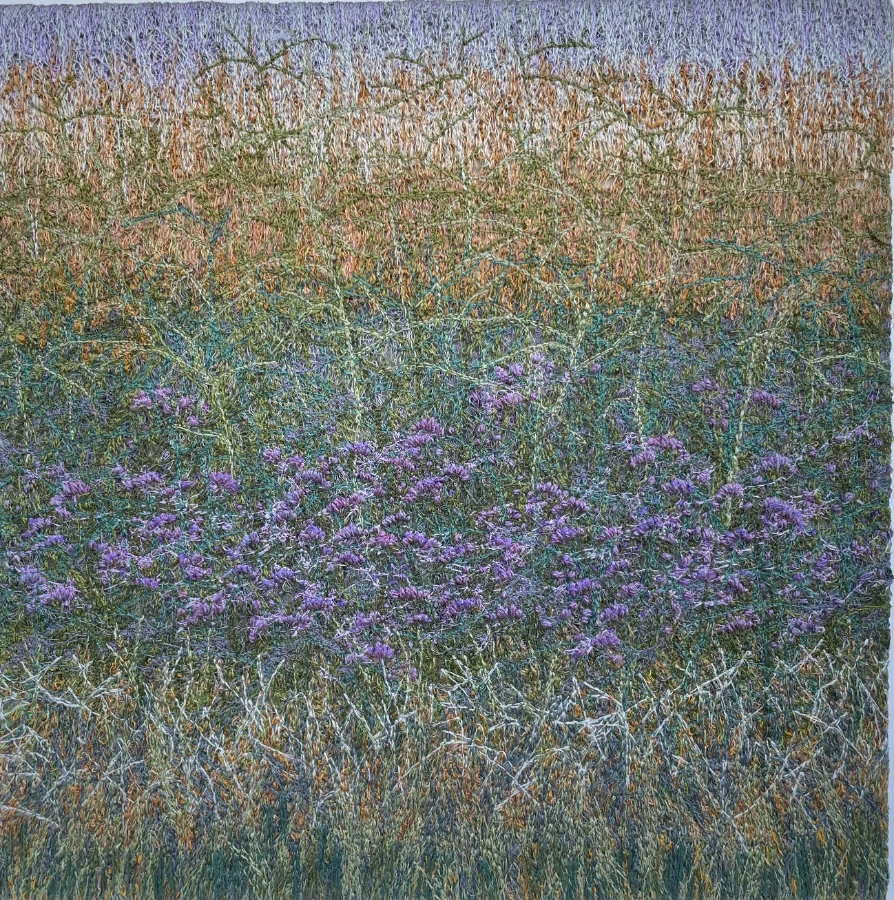
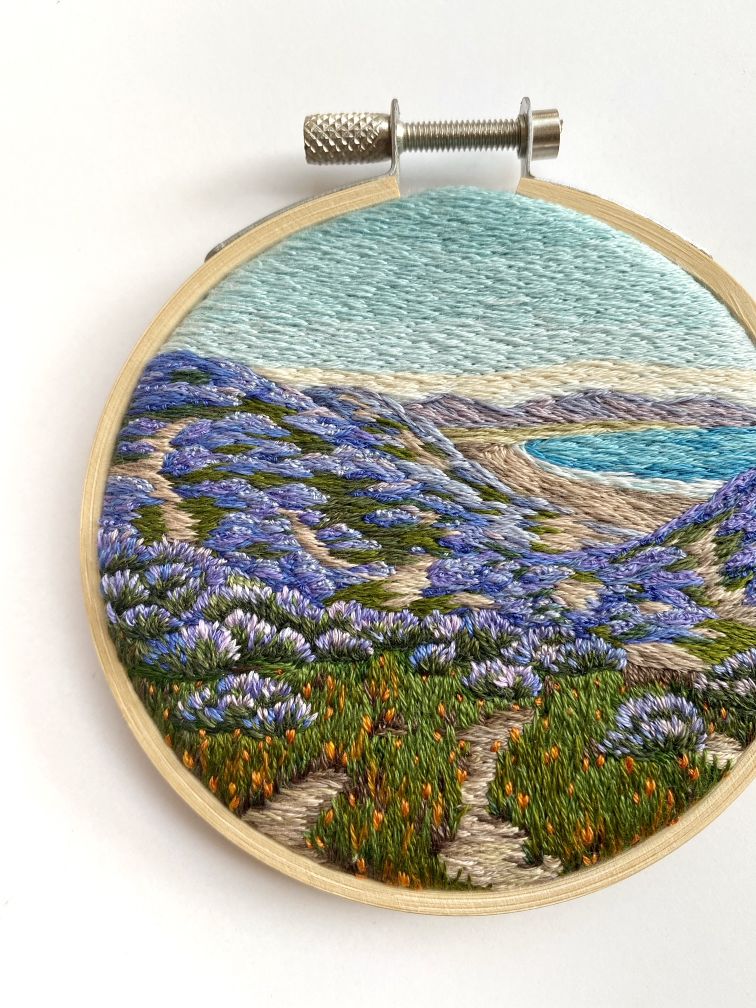
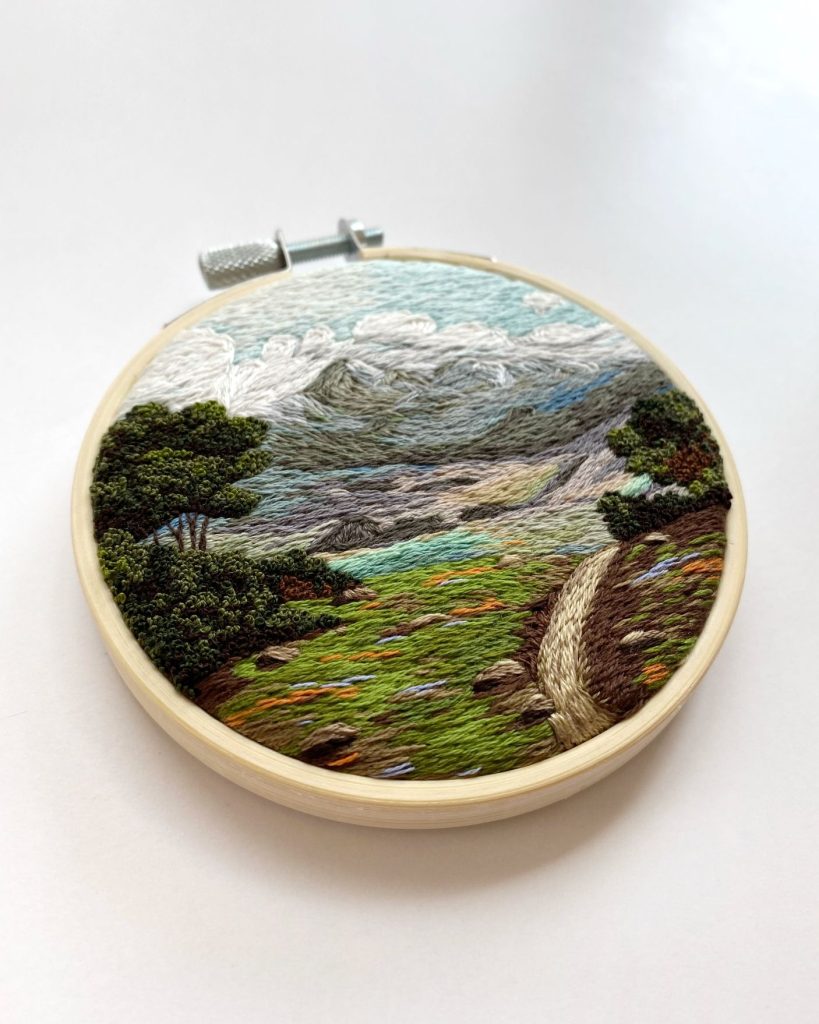
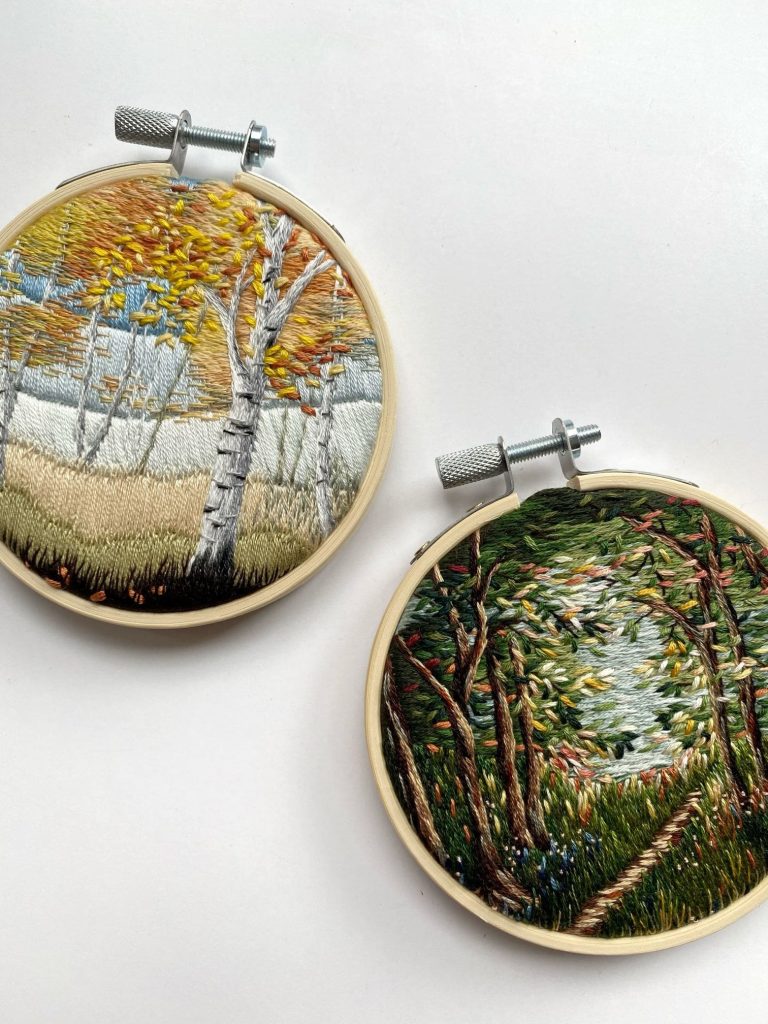
Cassandra Dias is the thread painter’s thread painter. Working from Southern California, she uses an impressionistic approach to embroidery that mimics the pointed, gestural movement of a paintbrush, but with the depth and physical texture that only stitched thread can provide. The result sits somewhere between the work of Van Gogh and a walk along a clifftop at golden hour.
Her subjects are richly varied: rugged cliffsides, sun-drenched vineyards, mountain ridgelines, autumnal trees, and seascapes, all rendered in stitches that seem, impossibly, to move. Dias came to this practice in 2020 and has built an extraordinary body of work in a remarkably short time. Her book, Richly Stitched Landscape Embroidery: Mastering Thread Painted Scenes, was published in 2026 and has been generating significant interest across the embroidery world.
We have written about Cassandra Dias before on the SST blog and we return to her here with good reason: her work keeps evolving, and each new piece surpasses the last. If you have not yet found her Instagram feed, it will be one of the best discoveries you make this week.
Read our full feature: Cassandra Dias, The Van Gogh of Embroidery
Follow Cassandra Dias
Instagram: @cassiemdias
Website: cassandramdias.com
10. Ludmila Gancova
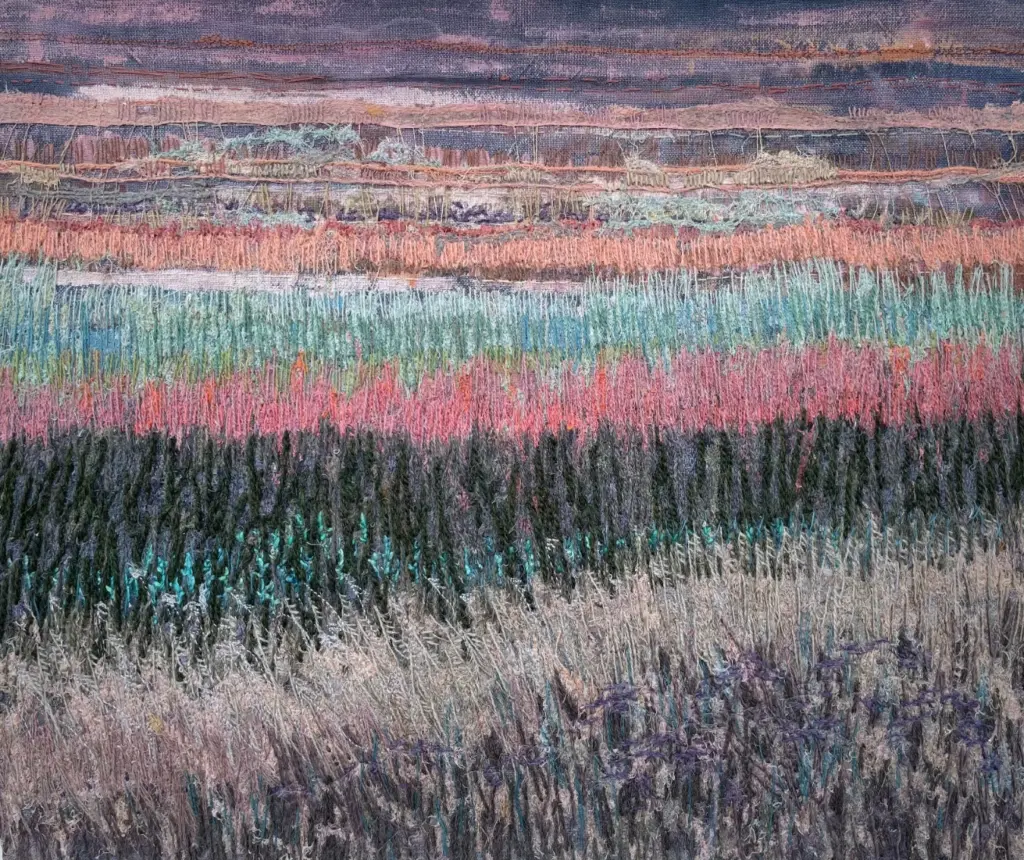
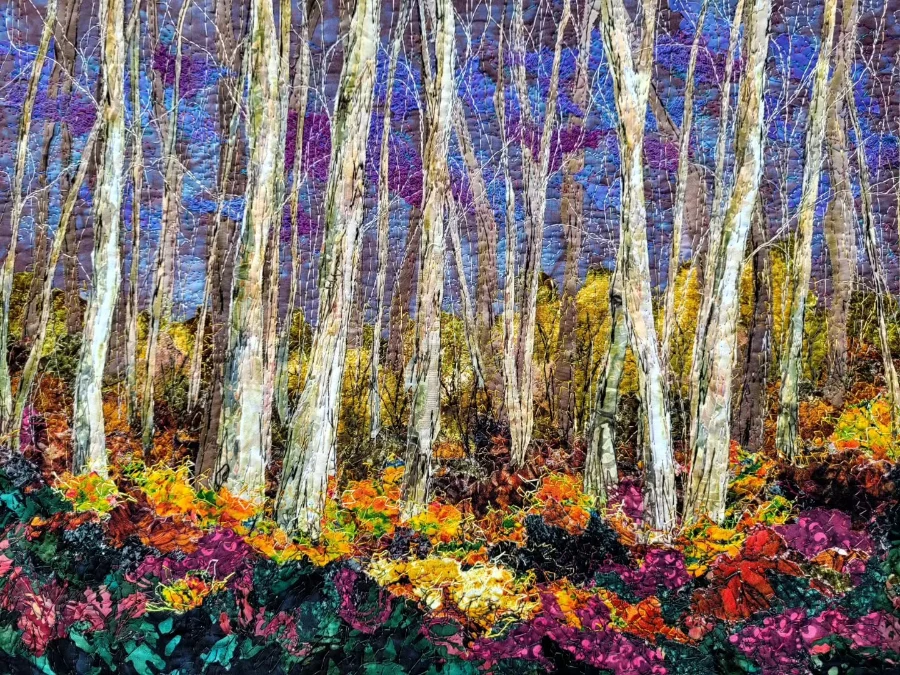
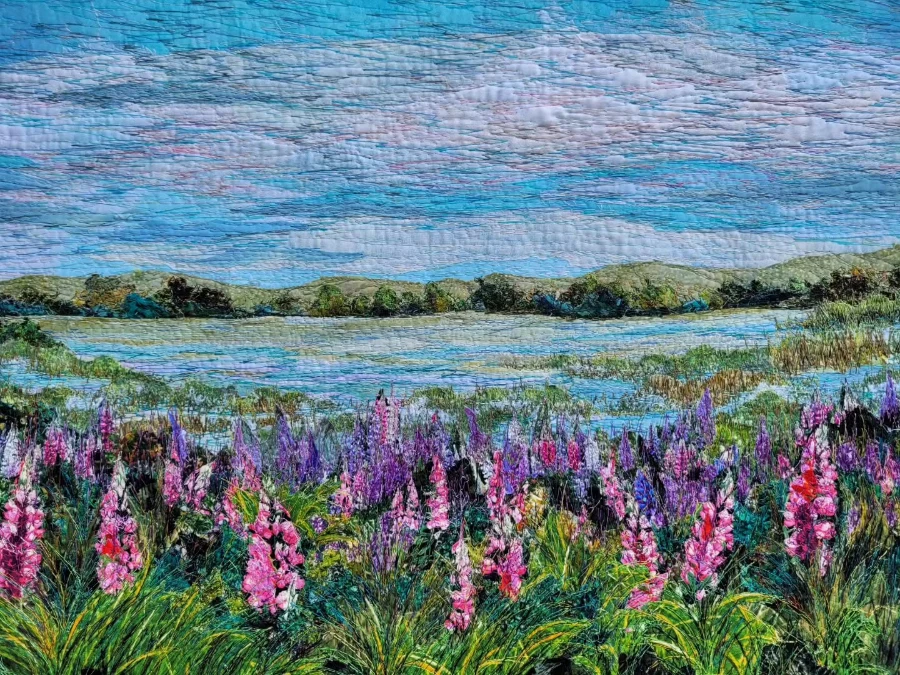
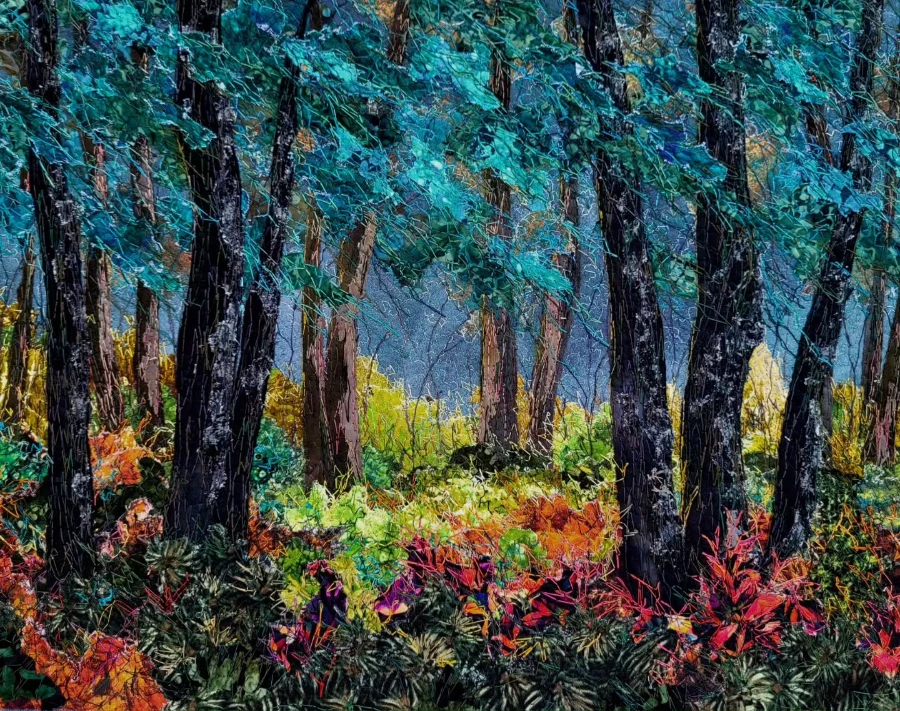
Ludmila Gancova works in textile art collage with thread painting: layering cotton, silk, polyester, hand-dyed cheesecloth, and tulle to build the composition, then working across the surface with variegated, metallic, and rayon threads to add depth, texture, and detail. The result is richly layered and richly coloured, with a vibrancy that draws you in before you even register the technique behind it.
Based in Wisconsin and drawing her imagery from personal photography taken on daily walks and travels, Gancova has developed a distinctive practice rooted in close observation of the natural world across seasons. Her work has appeared in Art Quilting Studio, Sew Somerset, and Sew & Tell, and she is featured in the book Stitched Journeys with Birds by Martha Sielman.
Perhaps the least widely known artist on this list, Gancova is precisely the kind of discovery this series exists to make. The textile art world is vast, and some of its most extraordinary practitioners are building their practice quietly, piece by piece, without the profile their work deserves. Seek her out.
Follow Ludmila Gancova
Instagram: @fiberartbyludmila
Website: ludmilagancova.com
The landscape has always been one of art’s great subjects. In textile art, it finds a medium that can do something paint and photography cannot: hold texture, suggest touch, and slow the viewer down. Every artist on this list knows that, and each has found their own way of stitching the world back to us, one thread at a time.
If you are inspired by what you have seen here and ready to develop your own textile art practice, explore SST’s City & Guilds Skill Stage programmes. From Skill Stage 2 through to Skill Stage 4, you will build the technical skills, creative confidence, and critical eye to make work that is entirely your own. Perhaps it begins with a landscape you already know and love.