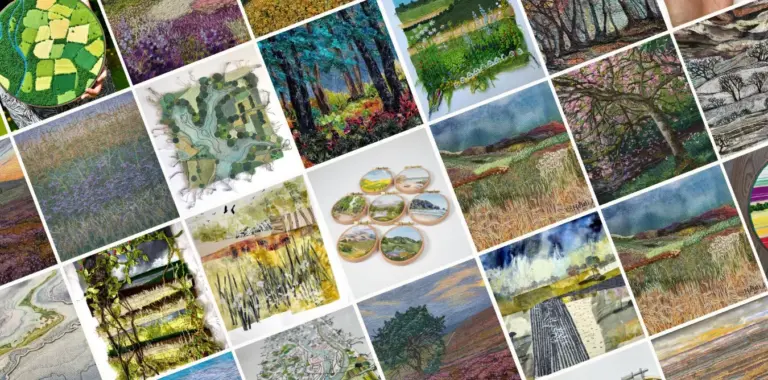
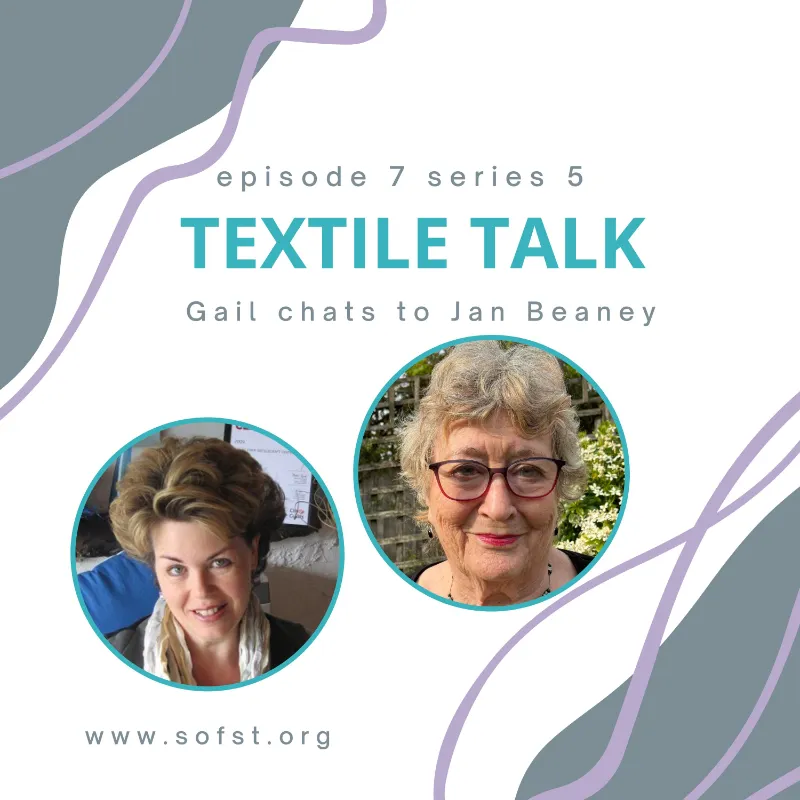
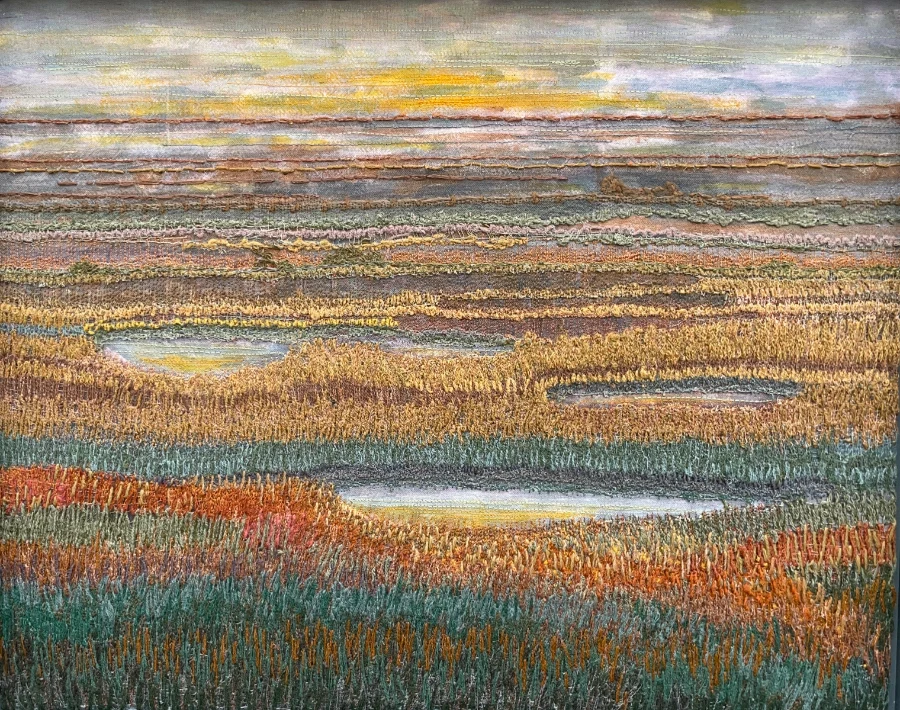
Jan Beaney’s machine embroidery begins long before a needle touches fabric. It starts in a sketchbook, with a scribble she would never show anyone else, built from a habit she calls simply looking, looking, looking. Beaney joined the 62 Group in 1963, within months of its founding, and is now its longest serving member. She went on to become Joint Chief Examiner for the City & Guilds Institute for Embroidery, and to build a body of work rooted entirely in landscape.
In this episode of Textile Talk, she talks candidly about the soluble fabric technique behind her layered textile pieces, the teaching career she stumbled into almost by accident, and the four decade creative partnership with Jean Littlejohn that produced books, DVDs and Double Trouble Enterprises. What comes through is an artist for whom drawing, colour and stitch remain inseparable, and who is still stopped in her tracks by a beech leaf catching the evening light.
Listen to Jan Beaney on Textile Talk – find the episode on your favourite podcast platform, or listen directly below.
Textile Talk with Jan Beaney
The episode is also available on Spotify, Apple Podcasts and all major podcast platforms.
Why Every Piece Starts With a Notebook, Not a Sketchbook
For Beaney, drawing is not a preliminary sketch, it is the foundation of the finished piece. She keeps what she calls a notebook rather than a sketchbook, filled with quick marks and scribbled colour notes made in the moment, whether from a car window in the Australian outback or a walk near home. “The more you look, the more you see” has been her mantra for decades, and she encourages students to keep their own notebooks private, away from family and friends, so the habit stays honest rather than polished.
She photographs a subject only after she has drawn it, arguing that the first marks capture the decision about what actually mattered enough to stop and look. It is this instinct, more than any single technique, that shapes every piece of Jan Beaney machine embroidery that follows.
From Reluctant Painter to City & Guilds Examiner
Beaney trained as a painter, not an embroiderer. She went to art college in an era when art school itself was frowned upon, supported by parents who let her have a go and an uncle who worked as art editor of Punch. Her mother, worried about a painter’s uncertain income, encouraged her to add a teaching qualification, and it was during teaching practice that Beaney discovered the biggest surprise of her career: she loved it.
Her first post landed her with a class of O level embroidery students, and she found herself, in her own words, one page ahead of them in the textbooks. Learning the City & Guilds embroidery syllabus alongside her pupils gave her a grounding in technique and history that shaped everything that followed, and led directly to her later role as Joint Chief Examiner for the City & Guilds Institute for Embroidery.
For anyone inspired by that same structured route into textile art, SST’s City & Guilds accredited courses offer a comparable foundation today, with study progressing through Skill Stage 2, Skill Stage 3 and Skill Stage 4. Find out more at by visiting our accredited Textile Courses.
The Soluble Fabric Technique Behind Her Layered Landscapes
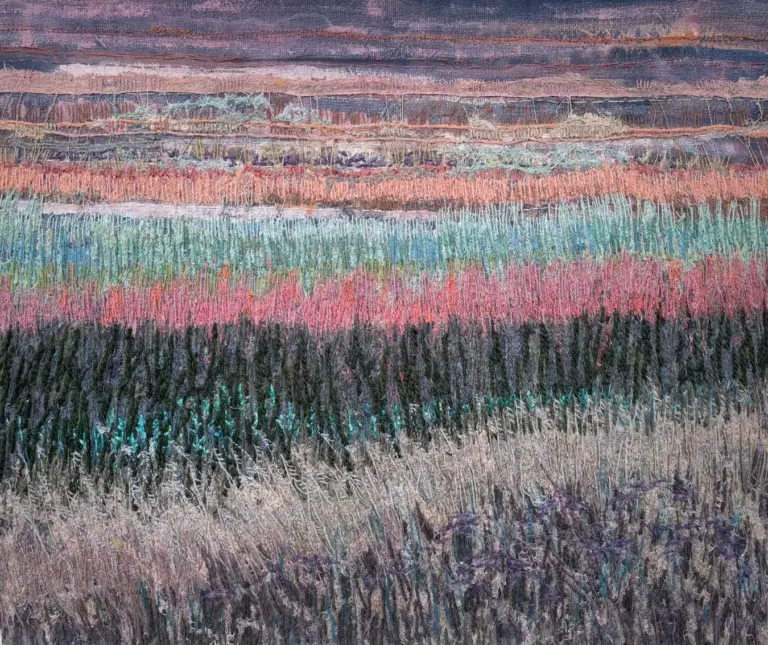
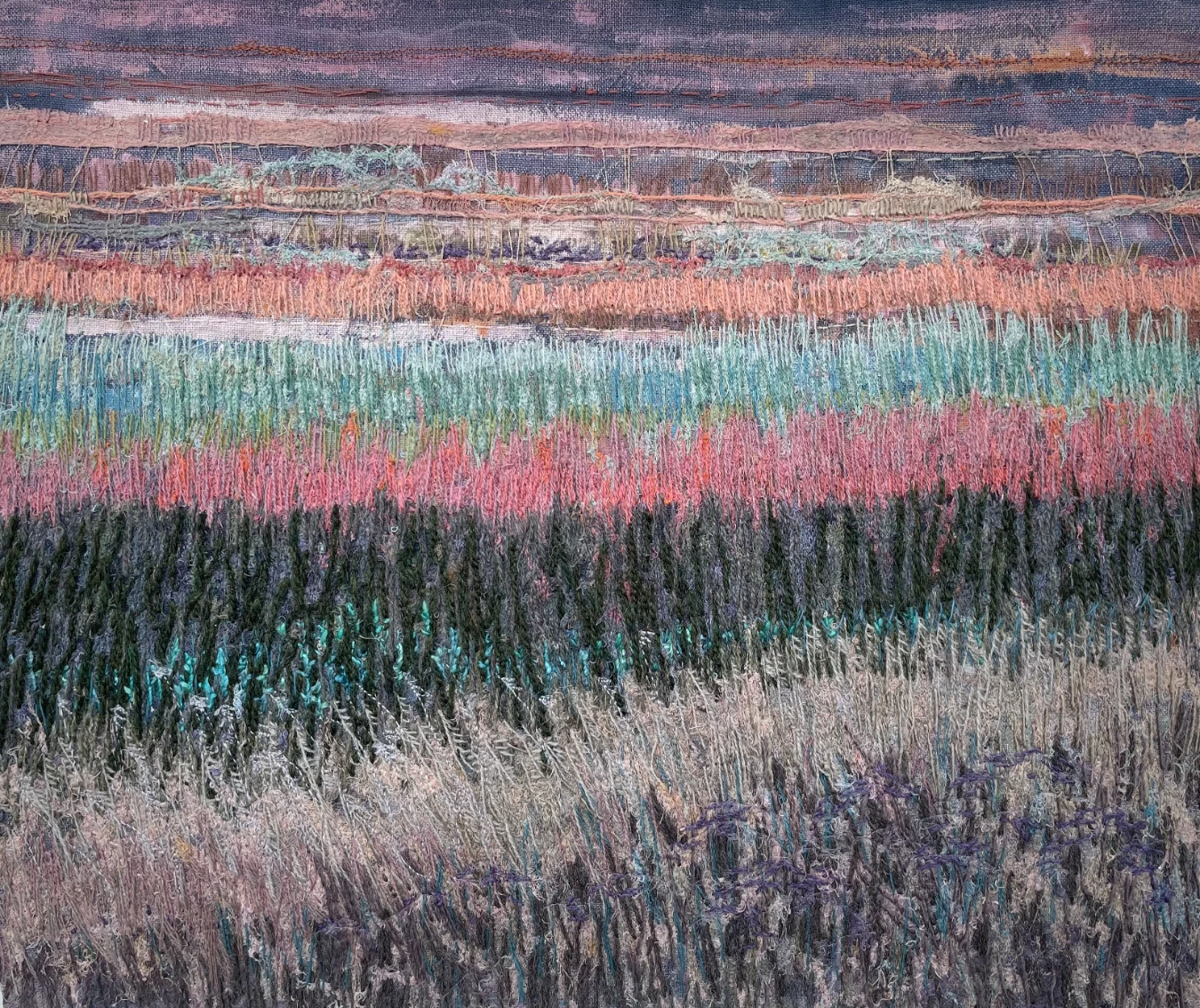
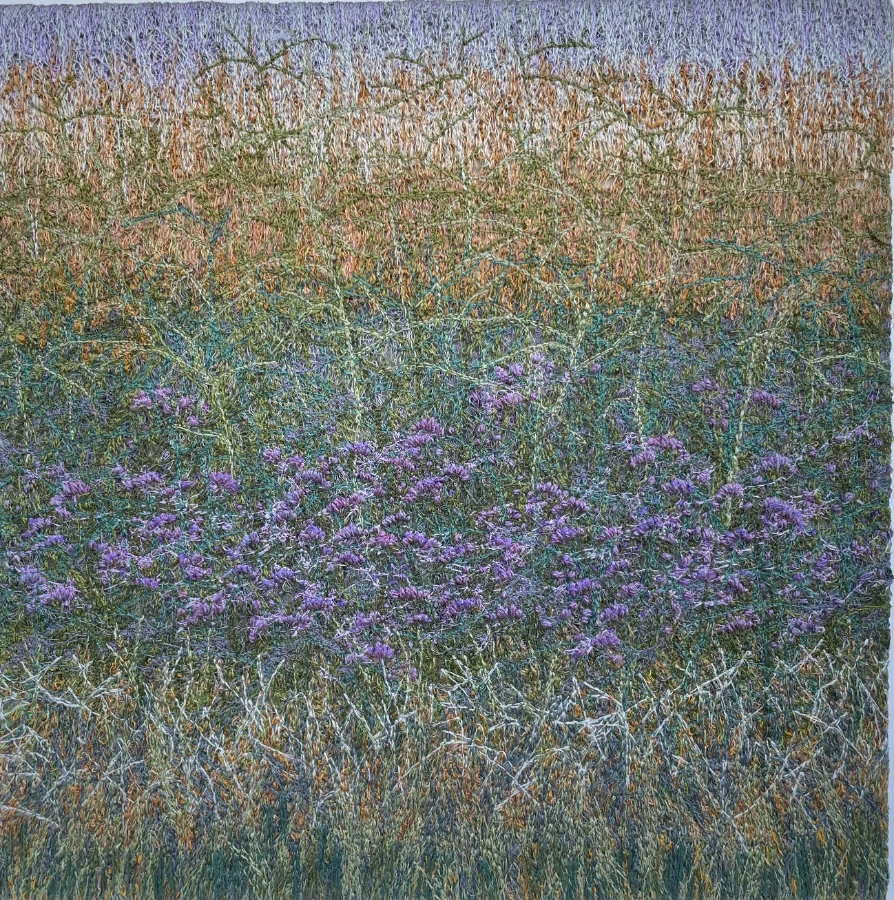
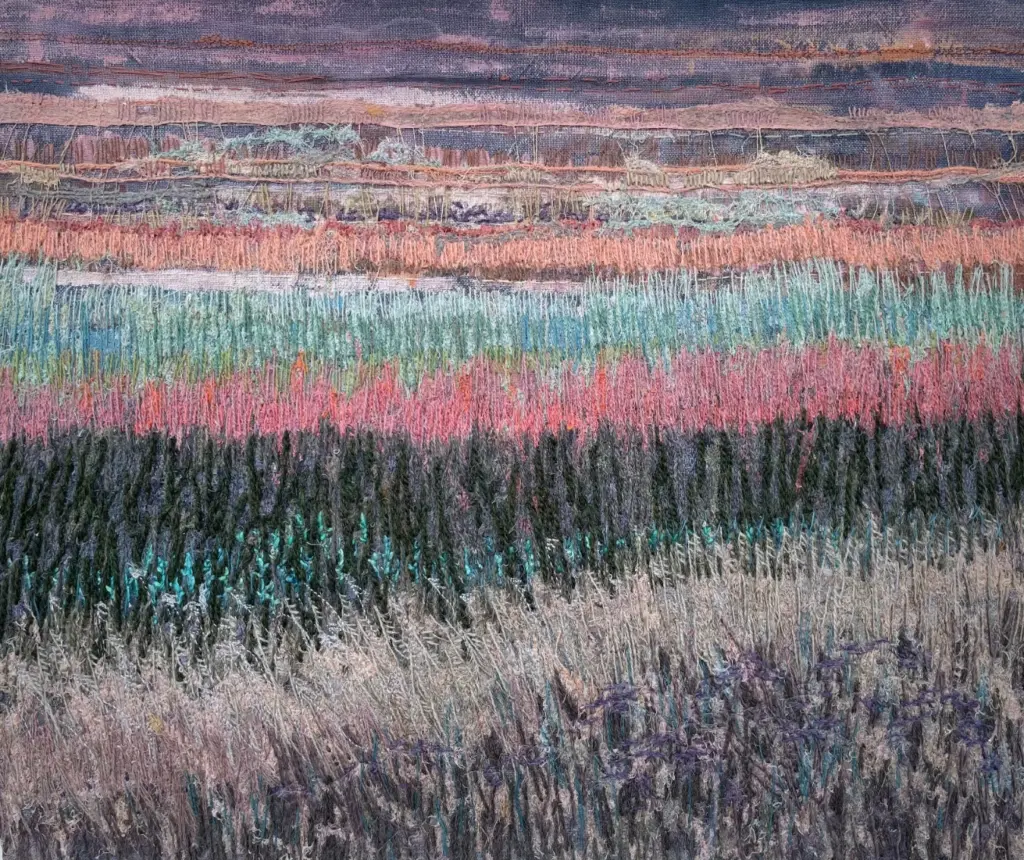
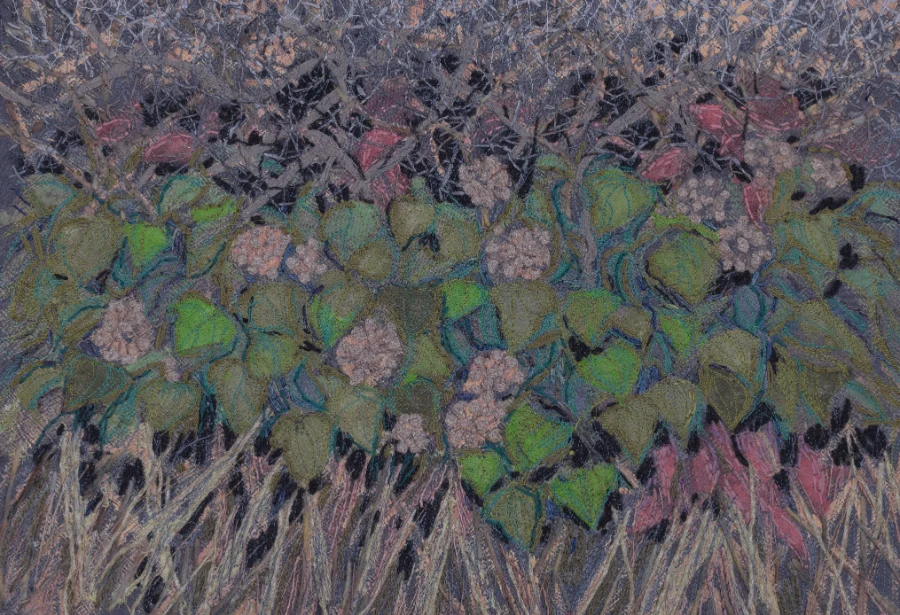
Much of Beaney’s current work begins with solufleece, a soluble fabric she draws on in coloured pencil before building layers of machine and hand stitching on top. She favours variations of straight stitch, running stitch and cross stitch to create movement, texture and rhythm, working almost exclusively in fine wool threads such as Lana Madeira.
When working with solufleece, she initially constructs the background and then dissolves and pins out the work on a board to stretch. When dry, she tacks the work on to more solufleece to support the background network in order to build up the layers of hand stitches and further machining before washing it several times, followed by stretching out again and finally lacing over card before framing.
It is a slow, exacting process, and one she has refined since first encountering soluble fabric in the 1980s, when health and safety rules still allowed boiling water to be used in the classroom. She also varies her process to employ dyed fabrics for backgrounds on occasion.
Double Trouble: A Creative Partnership Built on Difference, Not Sameness
Jean Littlejohn first walked into one of Beaney’s classes as a heavily pregnant primary school teacher in the 1970s. What began as a shared teaching post at Windsor College grew into joint City & Guilds examining duties and, in 1997, the founding of Double Trouble Enterprises, formed after a publisher’s collapse cost several textile authors their royalties.
The partnership has produced numerous books and instructional DVDs, built not on the two artists working alike but on working differently. Beaney describes a working method where one suggests a theme, such as red or fragile fabrics, and the other responds in her own voice. Despite decades of collaboration, each still keeps her own studio and her own creative privacy until a piece is ready to share.
Still Exhibiting After Six Decades: Stitch Unbound and the 62 Group
As the longest serving member of the 62 Group, now an honorary exhibiting member, Beaney no longer risks losing her membership if a piece is rejected, though she still submits work whenever she can. At the time of recording she was preparing several new pieces for Stitch Unbound, an exhibition at the Willow Gallery [Note to editor: please confirm exact gallery name and location, as this was unclear in the audio], filling a two metre by two metre space alongside work by Jean Littlejohn.
She reflects candidly on how exhibiting has changed. Galleries such as the Society of Designer Craftsmen now expect framed, professionally presented work, a shift from the free hanging textiles that once dominated 62 Group shows, and one she navigates while staying true to her own observational, landscape led approach.
Advice for Anyone Building a Creative Life in Textiles
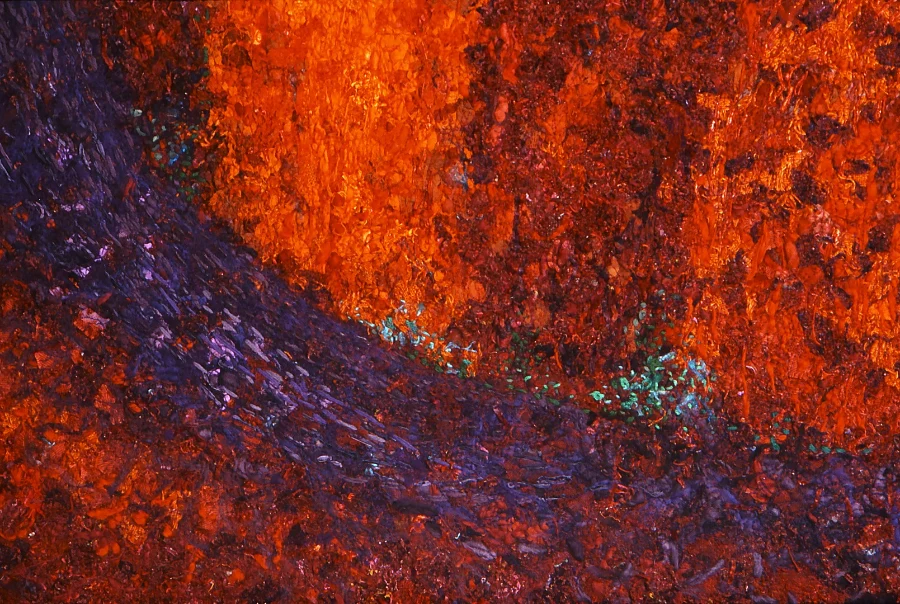
Beaney is candid that very few textile artists earn a full living purely from selling their pieces. Her own advice to students considering a creative career is to find work that supports the practice rather than compromises it, whether that is teaching, another job entirely, or a craft made for sale rather than exhibition.
For Beaney herself, teaching turned out to be the unexpected gift of her career, the thing she says she misses most. Decades on, she is still excited by nothing more complicated than changing light on a landscape, still keeping her notebook close, and still, as she puts it, looking, looking, looking.
Ready to hear the full conversation? Listen to this episode of Textile Talk on Spotify, Apple Podcasts or your favourite platform, or listen directly via the link below. It is a conversation that rewards close listening, much like Jan Beaney’s own approach to her work.
Jane Beaney: Discover More
Exhibition: Jan’s work is currently on exhibition at Willow Gallery, Oswestry, Shropshire SY11 1AD until 29th August 2026. Please check opening times directly with them on their site
Website: doubletrouble-ent.com
Instagram: @doubletroublejanjeanofficial