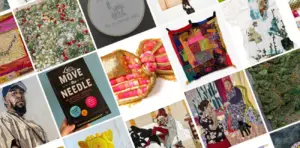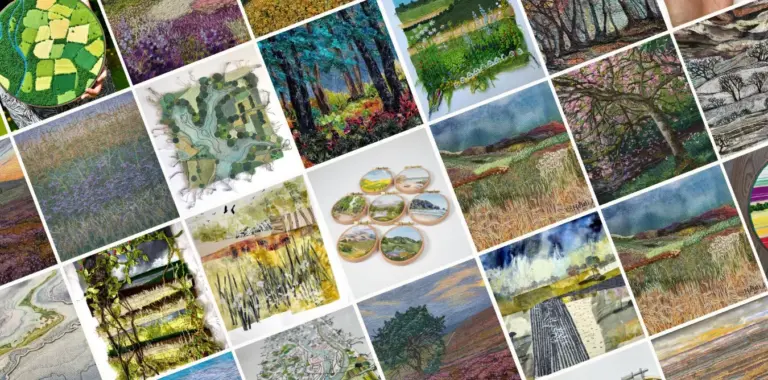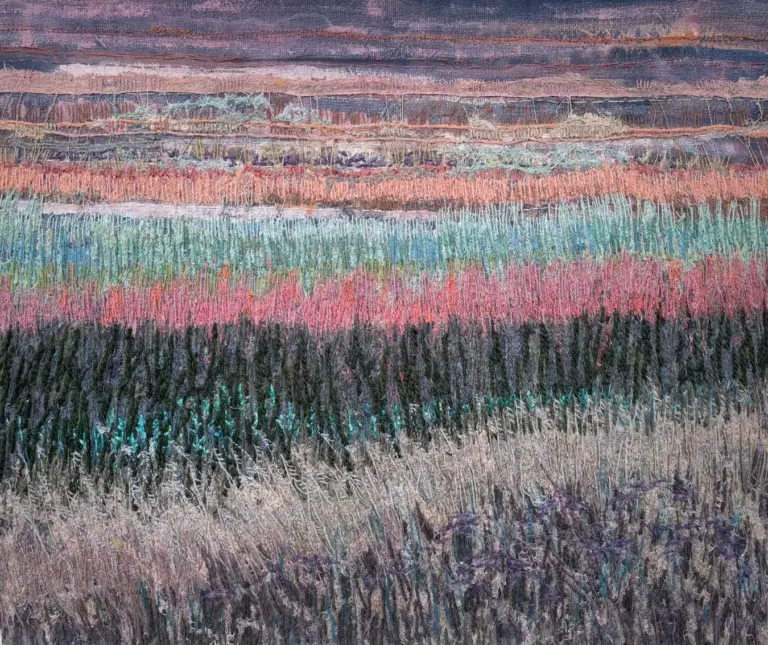
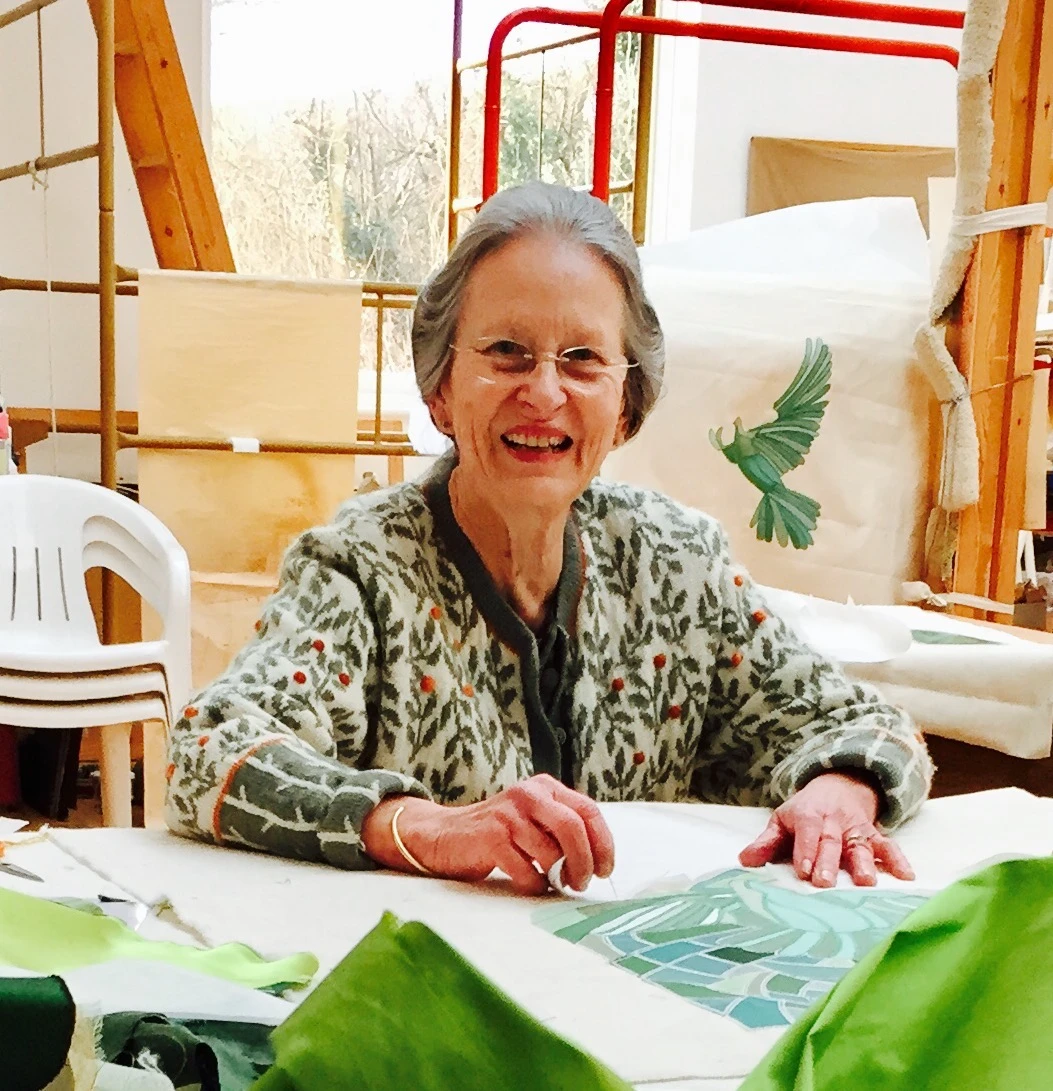
There is only one collection of its kind in the world. Over 300 works of contemporary British embroidery and stitch-based textile art, assembled over more than six decades, each piece acquired directly from the artist. It is the life’s work of Diana Springall MBE, and it began, she tells Gail Cowley on this episode of Textile Talk, with a simple professional need: she wanted something real to show her students.
Diana Springall MBE is one of Britain’s most celebrated textile artists, teachers, and advocates for embroidery as a serious art form. Trained as a painter at Goldsmiths College of Art, she spent decades creating large-scale commissions, training teachers, championing embroidery in prisons through Fine Cell Work, and quietly building a collection that experts now regard as the most significant of its kind anywhere in the world.
In this richly personal conversation, recorded at her home in Kent, Diana speaks with characteristic candour about her extraordinary life: from a childhood in India before Partition, to the prejudice she faced as a woman pursuing art, to her decades-long campaign to persuade institutions like the V&A that contemporary embroidery deserves a stage. She also shares what she looks for when judging the Hand and Lock Prize, what she believes makes an exceptional textile artist, and what she hopes will happen to her collection after she is gone.
Textile Talk with Diana Springall MBE
The episode is also available on Spotify, Apple Podcasts and all major podcast platforms.
Born in India, Shaped by Stitch
Diana Springall was born in India, and she and her brother spent their earliest years without formal schooling. “We played and drew and painted,” she recalls, “and my mother was a keen embroiderer of kits, so I learned to sew early on.” When Partition forced the family to leave in 1948, nine-year-old Diana was placed in a boarding school in Edinburgh, arriving into one of the coldest winters Britain had seen. The school kept her in bed for the entire first term, worried by how blue she looked.
It was her art teacher, Nina, now 93, who would change the course of Diana’s life. When her parents objected to her applying to Goldsmiths College of Art (“Be a secretary. Be a nurse. Do something sensible”), Nina fought for her. “Without her, it wouldn’t have happened,” Diana says quietly. “I wouldn’t have had the courage.” She still visits Nina today.
From Goldsmiths Painter to Pioneer of Embroidery
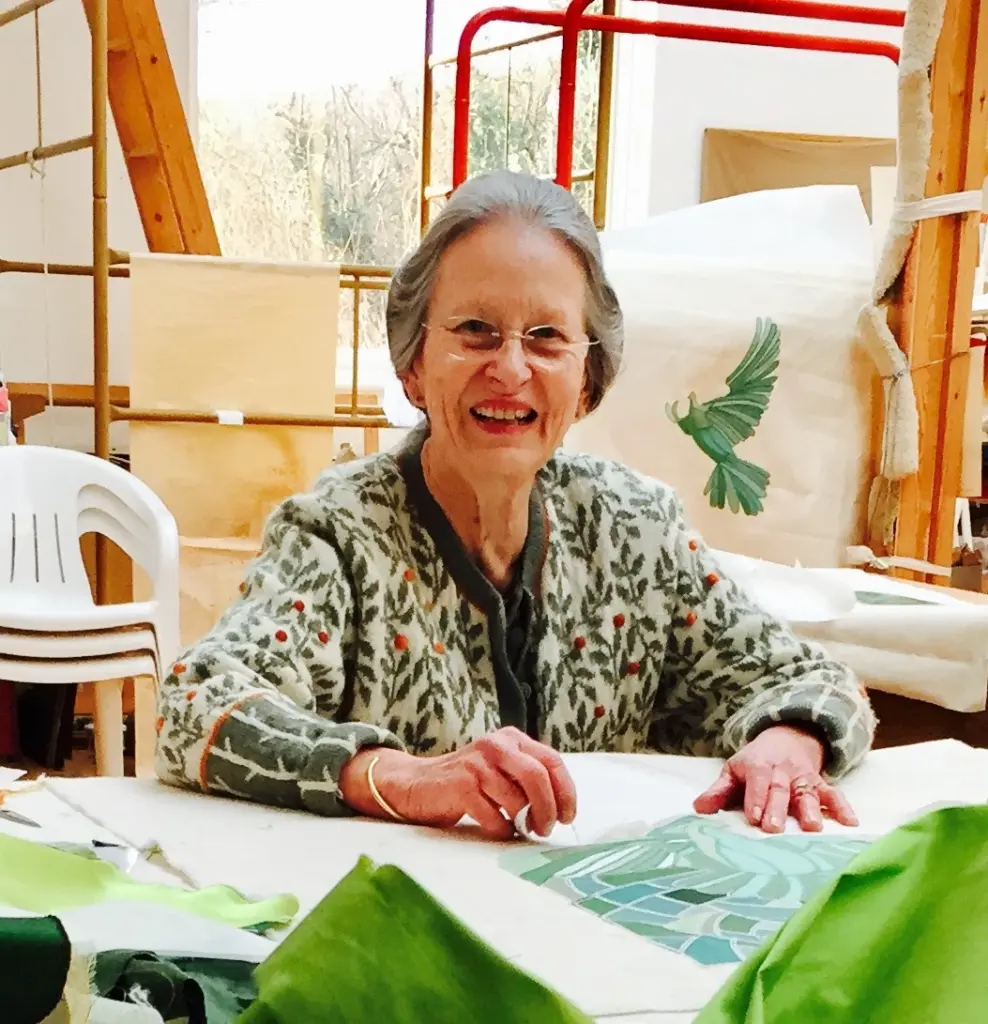
At Goldsmiths, Diana chose painting, one of only ten students in the fine art stream. It was there that she encountered Constance Howard, whose single-handed campaign to have embroidery recognised as a legitimate examination subject had transformed what the college could offer. “She was absolutely mad,” says Diana, with evident affection. “But it’s where it all started. Because of her, she got the fine art element going into embroidery.”
When Diana moved into teacher training in her fifth year, knowing that a woman in the mid-1970s would struggle to have a career in fine art, she included embroidery as one of her chosen crafts. She went on to train secondary school teachers at Bromley College, and quickly recognised how accessible and powerful embroidery could be in the classroom: “It cost nothing materially. You didn’t need fancy space. You didn’t need much. And it would be a wonderful, wonderful addition.”
For those inspired by Diana’s commitment to formal learning in textile arts, SST offers City & Guilds accredited home study courses at Skill Stage 2, Skill Stage 3, and Skill Stage 4, supporting students from beginner to advanced level with expert tutor guidance.
Commissions on a Scale Most Artists Never Attempt
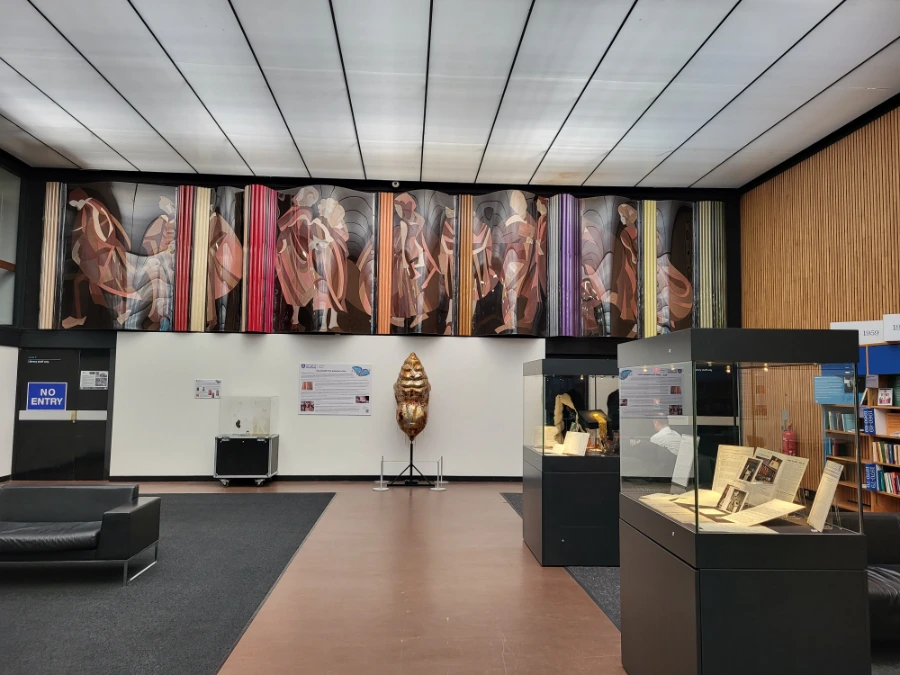
Diana’s reputation as a maker of monumental work grew organically, one commission leading to the next. Her panel for the University of Sheffield remains one of the most breathtaking examples of large-scale embroidery in any British public building. Measuring 46 feet wide and 8 feet high, it depicts graduation day scenes she sketched on site, with the silk regalia from each faculty’s academic hoods incorporated as decorative tubes between figures.
The commission came about through the Sheffield branch of the Embroiderers’ Guild, and the brief initially asked for a landscape. “I looked at the site and thought, no,” Diana recalls. “I came up with the subject of students coming into university and walking through.” She sat on graduation day, observing and drawing, then translated it into sections of appliqué silk, finished on her Bernina, the Swiss-made machine her parents bought her for her twenty-first birthday and which continues to run perfectly today.
She also completed major commissions for Jewish synagogues in London, and a panel for Logica, the computer company, in which she reimagined the interior of a motherboard in fabric and thread for their London headquarters. The work was made in collaboration, with members of her workforce and home students stitching sections alongside her. “I loved working to that scale,” she says, with no equivocation.
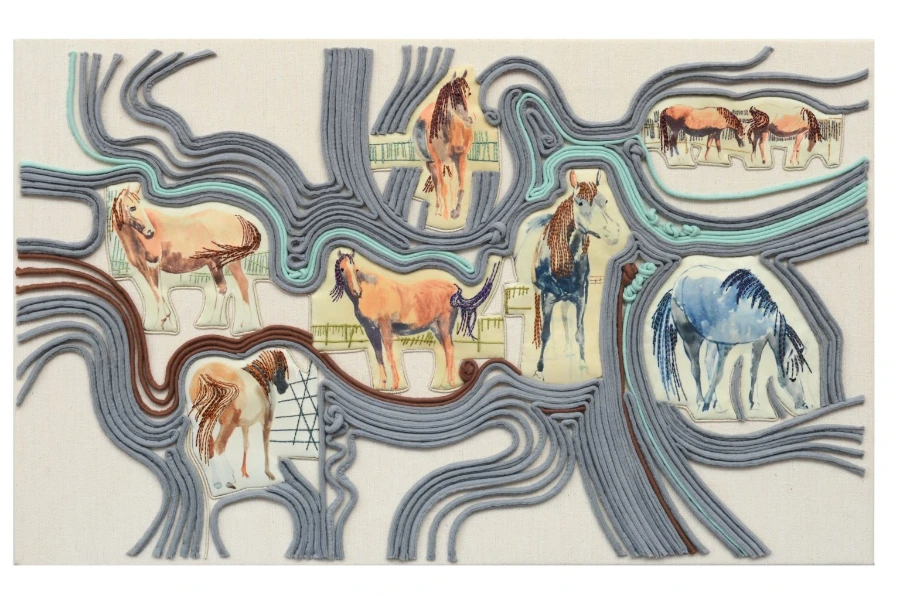
A Collection the World Has Never Seen Exhibited
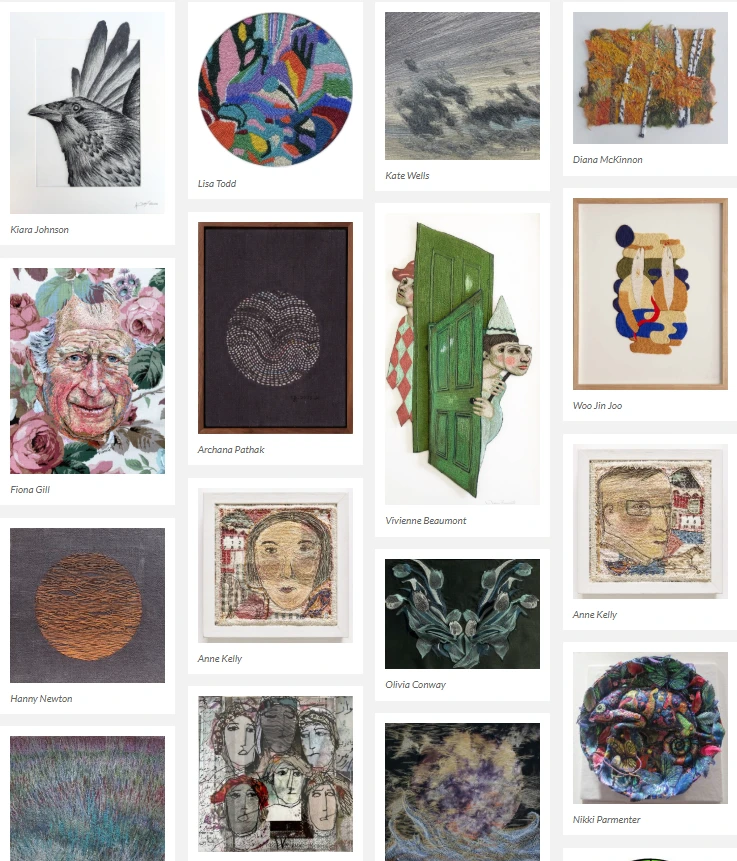
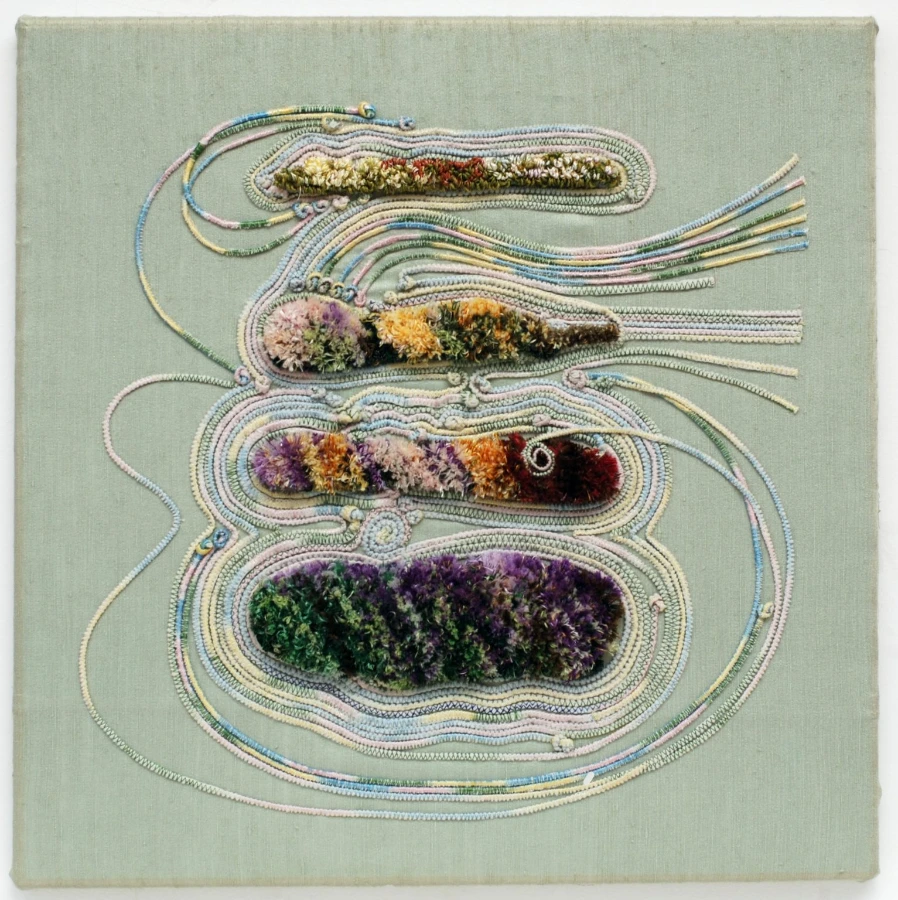
Diana began collecting embroidery in 1960, the year she qualified as a teacher. She needed actual works to show her students, pieces they could handle and turn over. Her very first purchase was a small framed landscape by Suzanne Arment, dated 1961: silk-based, with padded appliqué and extraordinarily free stitching. It hangs in her home still, and she considers it, after more than 300 subsequent acquisitions, her favourite. “Because it has meaning,” she says simply. “And it’s beautiful.”
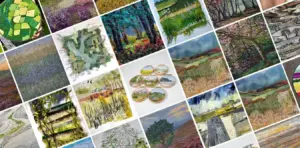
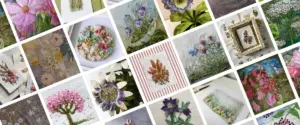
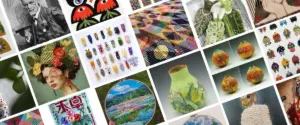
The collection is now widely regarded as the most comprehensive collection of British contemporary embroidery and stitch-based textile art in the world. Every piece was bought directly from the artist. Many were gifts. “Some of our leading names have said, ‘I went to buy it, but no, it’s for that fabulous collection, I’ll give it to you,'” Diana recalls. Her guiding principle was never complicated: “If I loved it and I could afford it, I bought it.”
As featured in the RSA Journal (Issue 4, 2024), the collection is described as “a testimony to the wonder of this craft as an art”. Diana is an FRSA, and the article details the urgent need for the Sunbury Embroidery Gallery extension, now the planned permanent home for the collection. Planning permission has been secured, and fundraising for the projected £3.5 million construction is underway. “I am 86 years old, and there is no time to waste,” Diana told the Journal.
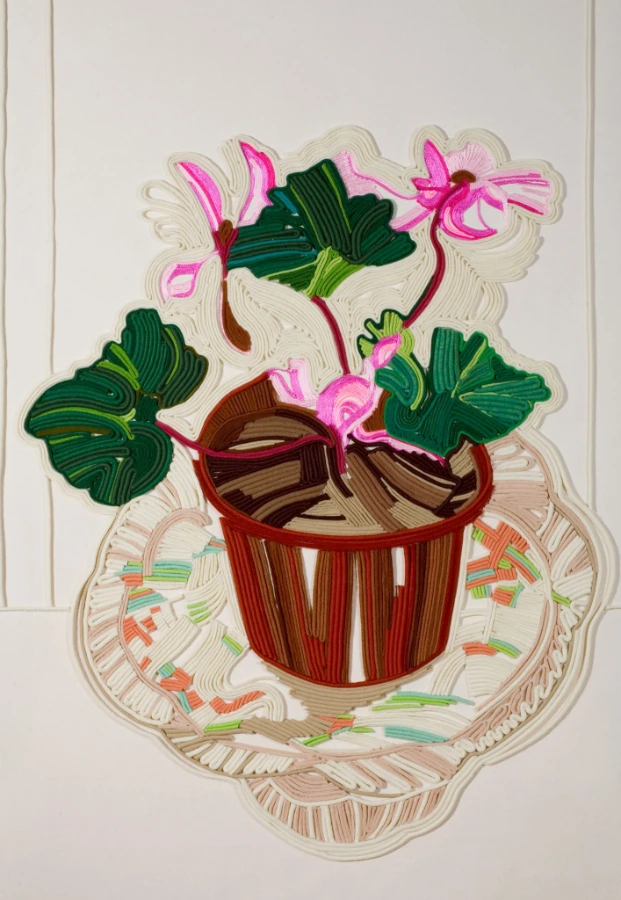
Embroidery at the Bottom of the Heap
Diana has spent her career fighting a battle she describes with quiet, unflinching wit. At a “posh lunch in the city”, a fellow guest asked what she did. She braced herself, said she was an embroiderer, and waited. “There was a pause,” she recalls. “So I helped him out: ‘The fine art world in which I was trained has very little regard for the crafts, and the bottom of the crafts is embroidery.’ There was another pause. He said, ‘I think baskets might be lower.'”
The problem, both Diana and her host Gail Cowley agree, is rooted in the history of embroidery as women’s work. “You got the words,” Diana tells Gail. She has tried for years to persuade the V&A to mount a contemporary embroidery exhibition, meeting with Tristram Hunt, the V&A’s director, through the connections of a friend. “He pretended to be interested,” she says. “There has never been a contemporary embroidery exhibition anywhere in the world. And mine is the only collection in the world of contemporary art embroidery.”
She also talks about Fine Cell Work, the charity for which she has volunteered for over 25 years, which teaches embroidery to prisoners serving life sentences. At its 25th anniversary party, she met a man who had spent 38 years inside. “He said, ‘I don’t know what I would have done if I hadn’t had embroidery.’ And I looked at their work and thought, I can’t embroider like that. Beautiful, beautiful standard of work.”
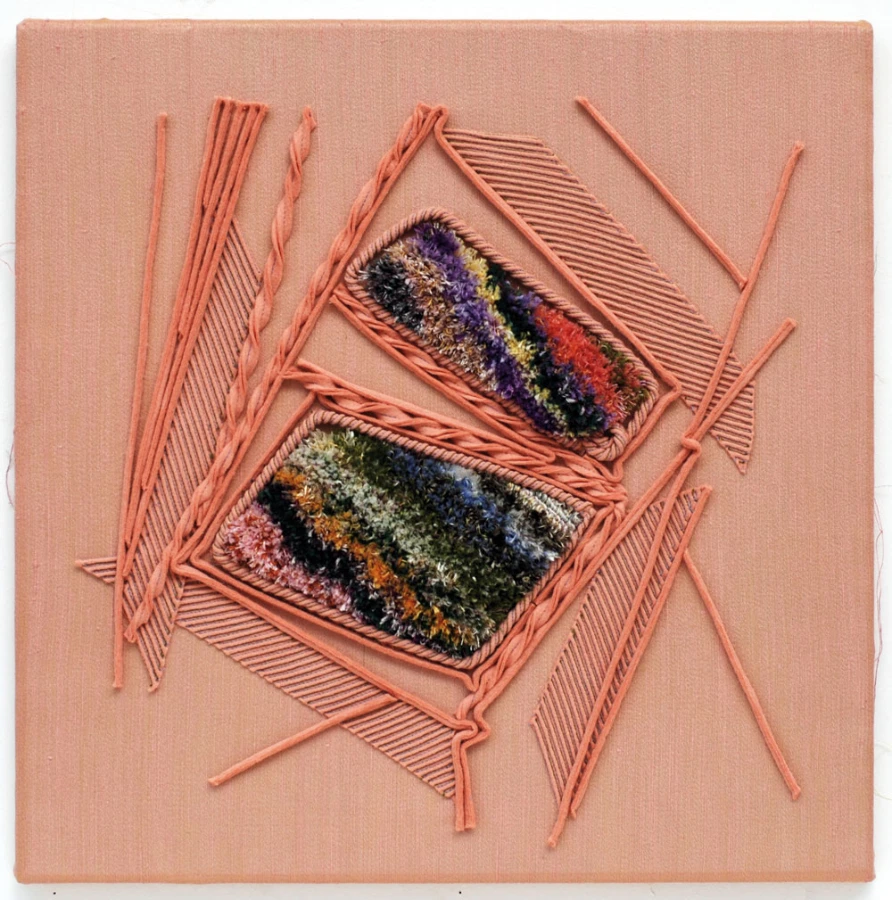
What Diana Springall Looks for in an Exceptional Textile Artist
As a judge for the Hand and Lock Prize, the internationally recognised embroidery competition that attracts 180 entries in the fine art category alone, Diana is required to assess both finished work and sketchbooks, understanding how each artist arrived at the piece. “Their perception, their drawings, and they write quite a bit about how they’ve reached that stage,” she explains. She values the journey as much as the destination.
For Diana, the mark of an exceptional textile artist is compositional intelligence. “I’m not looking just for a beautiful piece of texture. I’m looking for a piece of art.” She talks about positive and negative space, the relationship between busy areas and silence in a composition, and the way the best work reveals itself as a complete visual thought rather than a technical exercise. “It’s the perception that matters the most to me.”
Her advice to anyone starting out is disarmingly simple: “Draw something simple. Paint something simple. Paint what you think you can see. Is it textured? Is it linear? Is it dark? Is it light? Just looking. Looking at things.” And if it goes wrong? “Come back tomorrow and look at it.” She often finds, she says, that students return the next day and cannot remember which piece they thought had a problem.
Finding a Permanent Home: The Sunbury Embroidery Gallery
The question of what will happen to the collection has occupied Diana for years. The V&A, she feared, would put it in storage and nobody would ever see it. The Embroiderers’ Guild was not an option after she witnessed pieces from its collection being auctioned to fund operating costs. “£135,000 he made on one auction,” she says. “So there’s no way I could give it to the Guild.”
The Sunbury Embroidery Gallery in Sunbury-on-Thames approached her approximately nine years ago. When its directors visited and saw the collection, they made a promise: give it to us, and we will build an extension. That extension is now the subject of an active fundraising campaign. The new two-level purpose-designed space will include permanent gallery space for the collection, rooms for guest artists, a workshop, and study facilities, moving the gallery towards its vision of becoming a national centre for embroidery.
Diana has told Sunbury that she does not want her name on the building. “Whoever is going to be the donor paying for the extension, they can put their name on it,” she says. “We just need a wonderful donor.” If you would like to support the campaign, Sunbury Embroidery Gallery.
Listen Now
This is a conversation that stays with you. Diana Springall MBE has given the best part of a century to embroidery as an art form, as a teacher, as a collector, and as an advocate, and she speaks about it all with the kind of hard-won clarity that only comes from a life truly lived in the craft. Listen to the full episode of Textile Talk on Spotify, Apple Podcasts, or your favourite platform, or via the link below. Do not miss it.
Important Links
Listen now >>
Diana Springall’s Website